Artificial intelligence (AI) has long been more than just a buzzword; it is transforming entire industries. AI-based solutions are also increasingly being discussed in ESG reporting. But how much of this is actually reality in 2025? Which areas of application make sense? And where does AI reach its limits?
In this article, we examine the topic from various perspectives: technology-driven, regulatory, practical – and always with an eye on the central question: What really helps companies move forward?
What types of AI are there – and what does this mean for ESG reporting?
Not all AI is the same. Different types of artificial intelligence are used in the ESG environment, depending on the application and objective:
1. Rule-based systems
This type of “classic” AI follows strictly defined if-then rules. It is particularly well suited for structured, recurring tasks, such as validating input values or triggering workflows at certain thresholds. Advantages include high transparency and verifiability – however, flexibility is limited.
2. Machine learning (ML)
Here, an algorithm learns to recognize patterns and correlations from historical data – without explicit programming. In ESG reporting, ML can be used, for example, to identify outliers, for benchmarking, or in risk forecasting. Important: The quality of the results depends heavily on the database.
3. Natural language processing (NLP)
This AI discipline processes and understands natural language. It is used to analyze texts, such as sustainability reports, supplier communications, or emails. NLP can extract ESG-relevant content, categorize it, or convert it into structured data.
4. Generative AI (e.g., large language models such as ChatGPT)
Generative models can independently create texts, images, or other content. In ESG reporting, they are interesting for creating initial draft reports or for answering recurring questions via chatbot. However, their use requires particular caution due to limited traceability, hallucination risks, and regulatory requirements for verifiable content.
5. Hybrid models and assistance systems
Many modern solutions combine several AI technologies, such as ML with rule-based checks or NLP with generative AI. The aim is to provide practical assistance that performs automated preparatory work without replacing human experts. Such systems are particularly promising for implementing ESG reporting in complex organizations.
Status quo: Where does AI really stand in ESG reporting today?
Although there are numerous pilot projects, innovation initiatives, and initial productive applications, there will be no widespread use of artificial intelligence in ESG reporting by 2025. Many companies are closely monitoring developments but remain cautious about implementation. This is particularly true for large corporations that are caught between regulatory certainty and digital transformation.
The fact is that current requirements, such as those set out in the CSRD (Corporate Sustainability Reporting Directive) and the ESRS (European Sustainability Reporting Standards), initially focus on clean data, traceable processes, and verifiable results. This limits the scope for “black box” technologies such as generative AI.
The reasons for this reluctance are manifold – and concern not only the technology itself, but above all the framework conditions in which ESG reporting takes place:
- Regulatory uncertainties: Implementing the CSRD and the associated ESRS standards is already a significant challenge without the use of AI. The clear expectation for companies is to provide transparent, consistent, and verifiable reports. Technologies whose functioning is not entirely transparent, such as generative language models, are considered a risk in this context. A “black box” is difficult to justify from a regulatory perspective.
- Lack of data quality and data structure: The basis for any meaningful use of AI is a high-quality, structured, and consolidated database. In the ESG context, however, data is often fragmented, incomplete, or available in unstructured formats (e.g., PDF reports, Excel sheets, supplier emails). Such data formats make clean modeling and validatable results considerably more difficult.
- Internal reluctance: Skepticism prevails in many companies, especially in departments that are heavily involved in compliance, accounting, or sustainability. The focus there is not on innovation, but on ensuring accuracy and verifiability. A lack of AI expertise within the team and unclear responsibilities for new technologies also slow down implementation.
- Technological fragmentation: The market for AI-related ESG software solutions is still young and heterogeneous. There is a lot of movement – but also many isolated solutions. Standardized interfaces, industry-specific models, or fully integrated end-to-end processes are the exception.
- Legal uncertainty surrounding AI infrastructures: Many AI applications are currently based on technologies and cloud services from US providers such as Microsoft or Amazon Web Services. Despite data being stored in the EU, there is still uncertainty as to whether US authorities can access this data under certain circumstances without notifying the companies concerned or supervisory authorities. This raises data protection issues, especially in the ESG context, where sensitive information is processed.
Nevertheless, initial studies and practical examples show that there is potential, particularly in sub-processes with high data volumes or repetitive tasks. However, this is precisely where the challenge lies. AI must not only reduce the workload but also deliver reproducible results. This is a key aspect in the reporting context and cannot yet be guaranteed across the board. Those who use AI in the ESG context today usually do so in clearly defined areas, such as pre-structuring information, quality assurance, or intelligent support for report generation.
|
💡Demands for a fully automated “one-click” report, as heard occasionally in the market, are at odds with reality: AI is currently no substitute for human expertise, but rather a tool that, when used correctly, can make individual steps more efficient. |
|---|
Specific areas of application: Where does AI really make sense in ESG reporting?
There are already practical applications for AI today, especially where large amounts of data need to be analyzed or structured efficiently:
- Text recognition & classification: Classification of ESG-relevant content from unstructured documents, reports, emails, or websites (e.g., supplier reports, sustainability information, regulatory updates). AI can identify relevant passages, assign them to topics, and enter them into databases.
- Automated data validation: Detection of outliers, anomalies, plausibility checks, and comparison with internal benchmarks or external reference data. This allows sources of error to be identified and corrected at an early stage.
- Suggestions for report wording: Generative AI models (large language models) can provide initial text suggestions for sustainability reports based on existing data and reports – but always with human control and editorial post-processing.
- Risk assessment & forecasting: AI models can help with early warning of ESG risks, for example, by analyzing news, social media, or supply chain data. They also enable forecasts of emission trends, resource use, or the financial impact of sustainability measures.
- AI-supported chatbots and virtual assistants: Chatbots can support employees or reporting officers with data entry, questions about reporting standards (e.g., CSRD, GRI), or internal processes. They offer quick access to guidelines, FAQs or documented best practices, thereby reducing the workload of specialist departments.
- Automated collection of stakeholder feedback: AI can analyze feedback from stakeholder surveys, social media channels, or public forums to systematically evaluate opinions, concerns, and trends on ESG issues.
- Integration of ESG data from external sources: Artificial intelligence can automatically collect information from regulatory databases, industry data, or sustainability rankings, consolidate it, and check it for relevance.
- Visualization and dashboard optimization: AI algorithms help dynamically evaluate ESG data and suggest appropriate visualizations that give report recipients better insight.
- Speech recognition and automatic logging: In meetings or audits, AI-based speech recognition tools can automatically log relevant ESG discussions and prepare them for reporting.
-
Consolidation of distributed data sources: AI can assist in integrating ESG-relevant information from different internal databases, systems, or departments. Intelligent mapping and matching of data points can reduce inconsistencies, avoid redundancies, and create a consolidated overall picture.
Limitations of technology: What is not (yet) applicable or permissible
As promising as AI is, ESG reporting has specific requirements and challenges that limit the use of this technology:
-
Traceability and explainability:
AI results must be understandable and explainable in the audit process. This is often only possible to a limited extent, especially with complex models such as large language models (LLMs). The so-called “black box” problem means that AI decisions or assessments are not transparent enough to justify them from a regulatory perspective or defend them in audits. -
Quality and availability of the database:
AI is only as good as the underlying data. In the ESG area, data is often heterogeneous, fragmented, incomplete, or of varying quality. A lack of standardization, different data formats, and sometimes subjective assessments make valid AI analyses difficult. - Regulatory requirements and liability:
- The CSRD and other international standards require human responsibility and verified, reliable statements. Fully automated reports without human control are currently not permitted and are also not practical. Liability issues in the event of incorrect AI results are also still unclear.
-
Trust and reputation risk:
Sustainability reports are public and have an impact on investors, customers, and the general public. Companies do not take any risks with purely AI-generated content, as errors or inaccurate statements can severely damage their credibility. -
Ethical and social implications:
AI can adopt biases from training data and thus reinforce distortions in ESG risks or assessments. Human judgment is indispensable, particularly in the area of social aspects (e.g. working conditions, diversity), human judgment is indispensable. -
Dynamics and timeliness of ESG issues:
ESG standards, regulatory requirements, and social expectations are changing rapidly. AI models must be continuously adapted and trained—a significant effort that not all companies can afford. -
Lack of standardization of ESG criteria:
Since ESG reports use different focal points, frameworks, and key figures, there is no uniform basis on which AI models could work reliably and generalizably. -
Data protection and confidentiality:
The use of AI in ESG reporting requires particular care when handling sensitive data – for example, on suppliers, employees, or environmental impacts. It is crucial to ensure that this complies with data protection regulations, especially for cloud-based applications outside the EU. -
Technological limitations:
AI is good at patterns and predictions, but less suitable for evaluating complex relationships, qualitative assessments, or ethical evaluations, which are often necessary in ESG reporting.
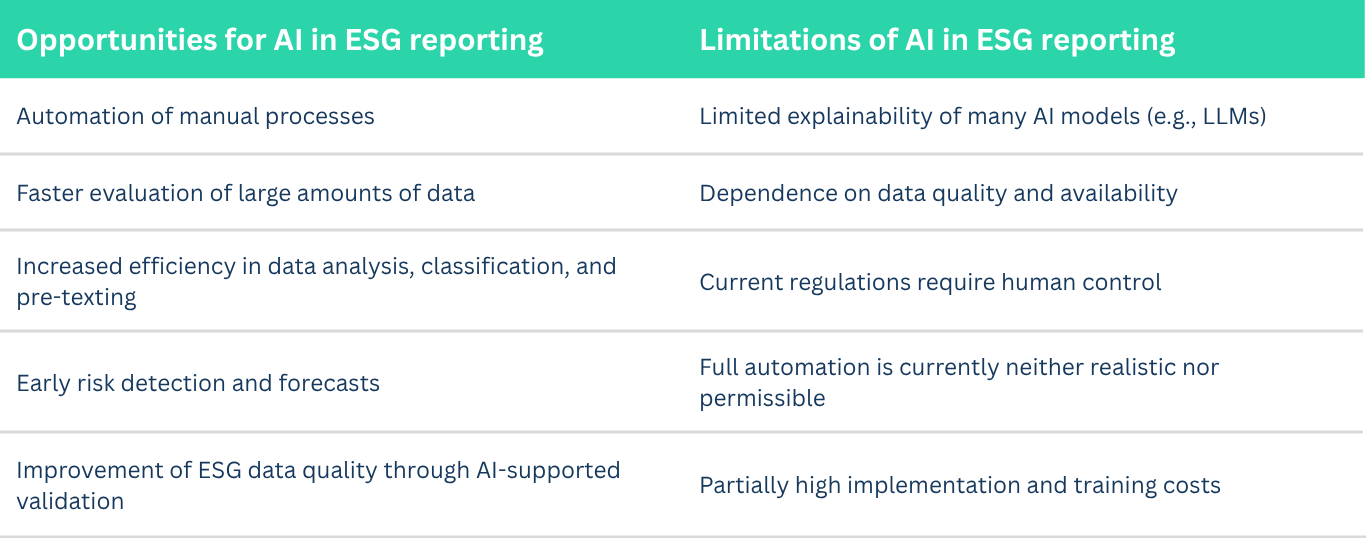
Opportunities and limitations of AI in ESG reporting at a glance
How Envoria supports ESG reporting with AI (as of September 2025)
Envoria, the all-in-one software for ESG and financial reporting, relies on the practical application of AI to efficiently support companies in complex ESG reporting – without relinquishing control. The focus is on solutions that relieve the burden on specialist departments while meeting the highest requirements for transparency, data quality, and regulatory compliance.
AI features already available in Envoria
- The Envoria Virtual Assistant (EVA): Integrated directly into your Envoria license, you can ask Eva questions about ESG reporting, modules, and processes – and receive instant, accurate answers. Eva guides you step by step through complex requirements, delivers clear explanations, and directs you to additional resources whenever needed. Especially for teams with varying levels of ESG expertise, this is a real advantage: Eva makes complex topics easy to understand, saves valuable time spent searching for information, and helps you reach your goals faster.
- AI-based Emission Factor Mapping: Envoria uses AI to automatically match consumption data with the appropriate emission factors. This accelerates the calculation of CO₂ equivalents, ensures standardization, and improves data consistency in emissions management.
- AI-powered Climate Risk Analysis: AI assists in identifying and assessing climate-related risks and opportunities, enabling companies to capture their impacts on business models more transparently and consistently.
- AI-powered Materiality Assessment (IROs): With Envoria, Impact, Risks & Opportunities can be systematically identified and evaluated. AI supports by structuring factors, assigning weightings, and presenting them in a comparable way.
→ All AI features are modular, GDPR-compliant, and continuously enhanced – taking into account current regulatory developments and user needs.
Upcoming AI Features
- Structured Data Collection and Validation: Using rule-based AI models, Envoria supports detecting outliers, performing automated plausibility checks, and benchmarking data. This enables faster data validation and early identification of potential errors.
- Text Recognition and Semantic Mapping: AI-powered functions assist in extracting relevant ESG content from unstructured sources such as supplier reports, audits, or emails, and accurately mapping it to the correct topics – delivering a significant efficiency gain in the reporting preparation process.
- Generation of Text Suggestions: During report creation, Envoria offers suggestion functions for formulations based on existing content. Final editing always remains under the user’s control, following a “human-in-the-loop” approach.
Conclusion: AI as a tool, not a replacement
AI in ESG reporting is not an end in itself, but a tool. Anyone relying on technology today should do so with clear objectives, a sound data basis, and appropriate use cases. Neither the idea of fully automated sustainability reports nor completely abandoning modern tools is the right approach. The pragmatic path lies somewhere in between: using AI in a targeted manner, controlling it consciously, and knowing its limits.
Practical experience shows that AI can effectively relieve the burden on ESG teams, especially when it comes to data-intensive tasks. However, the final evaluation, contextualization, and communication of sustainability-related content remain in human hands – and that is a good thing. Only the combination of intelligent technology and professional responsibility can result in ESG reporting that is both efficient and credible.