Since the adoption of ASC 842, many U.S. companies have revised their lease accounting processes; however, compliance remains an ongoing challenge. With increasing audit scrutiny and the growing complexity of global operations, the pressure to move beyond spreadsheets and manual workflows is rising.
This article examines the primary challenges companies continue to encounter under ASC 842, the role automation can play in addressing them, and why global compatibility is becoming increasingly essential for U.S. finance teams.
What is ASC 842 and why it still matters in 2025
ASC 842 at a glance
ASC 842 is the U.S. lease accounting standard issued by the Financial Accounting Standards Board (FASB) that fundamentally changed how companies account for leases. Its core requirement: virtually all leases must now be recorded on the balance sheet, including operating leases that were previously kept off-balance under ASC 840.
Since its phased introduction (2019 for public companies and 2022 for most private companies), ASC 842 has dramatically increased the visibility of lease-related assets and liabilities. It introduced new definitions, accounting treatments, and disclosure requirements that affect not only accounting but also internal processes, IT systems, and cross-functional collaboration.
While initial implementation is behind many organizations, ASC 842 remains a dynamic challenge in 2025, especially as companies expand, restructure lease agreements, or face heightened audit scrutiny.
Why ASC 842 is still important
- Auditors are digging deeper: Lease accounting is now a regular audit focus, with increased attention on assumptions, documentation, and system controls.
- Lease portfolios are not static: Ongoing modifications, early terminations, renewals, and remeasurements require continuous updates and accurate recalculations.
- Investor and stakeholder expectations are rising: Transparent, consistent lease disclosures are expected, particularly in sectors with material lease exposure (e.g., retail, transportation, manufacturing).
- Manual processes don’t scale: Many companies still rely on spreadsheets, increasing the risk of errors, missed updates, and lack of audit readiness.
- Cross-standard reporting is becoming more common: Multinational businesses often need to report under both ASC 842 and international frameworks like IFRS 16, adding further complexity.
Common challenges U.S. companies face with ASC 842 compliance
Despite years of experience with the standard, many finance teams still struggle with implementation and day-to-day maintenance. These issues not only risk non-compliance but also drain valuable time and resources:
- Manual lease data tracking: Lease terms, payments, and options are often stored in spreadsheets across departments.
- Data inconsistencies across entities: Global operations and decentralized lease management lead to fragmentation and errors.
- Handling complex lease changes: Modifications, impairments, and reassessments require precise calculations and audit trails.
- Lack of audit readiness: Many companies struggle to produce documentation and calculation logic when auditors request it.
- Disconnection between accounting and legal teams: Lease documentation and accounting assumptions often lack alignment.
Lease accounting audits: What triggers them and how to be prepared
Lease accounting has become a key focus in audits, particularly for companies with significant lease liabilities.
Auditors may review:
- Lease contracts and amendments
- Assumptions used for discount rates, lease terms, and classifications
- Calculation methods for ROU assets and lease liabilities
- Documentation of judgments and internal controls
- Consistency across reporting periods and group entities
To be audit-ready, organizations need:
- Centralized access to lease data
- Transparent calculation logic
- Version control and documentation history
- Approval workflows and internal controls
- Real-time reporting and disclosure capabilities
Software as a strategic enabler – not just a tool
Many U.S. companies have recognized that relying solely on spreadsheets is no longer sustainable. Modern lease accounting software provides significant advantages:
- Centralized lease repository across all locations and entities
- Automated calculations for ROU assets, lease liabilities, and remeasurements
- Standard-compliant reporting in line with ASC 842 and other frameworks
- Audit-proof documentation with history logs and evidence attachments
- Real-time collaboration between accounting, finance, and legal teams
→ Especially for companies with international operations, software like Envoria supports multi-GAAP environments, enabling parallel compliance with ASC 842, IFRS 16, HGB, and FRS 102 – all within one solution.
Global outlook: What U.S. companies need to know
ASC 842 vs. IFRS 16
For U.S.-based companies with international subsidiaries or operations, understanding the differences between ASC 842 and IFRS 16 is critical. While both standards aim to improve lease transparency by bringing leases onto the balance sheet, they differ significantly in application and impact.
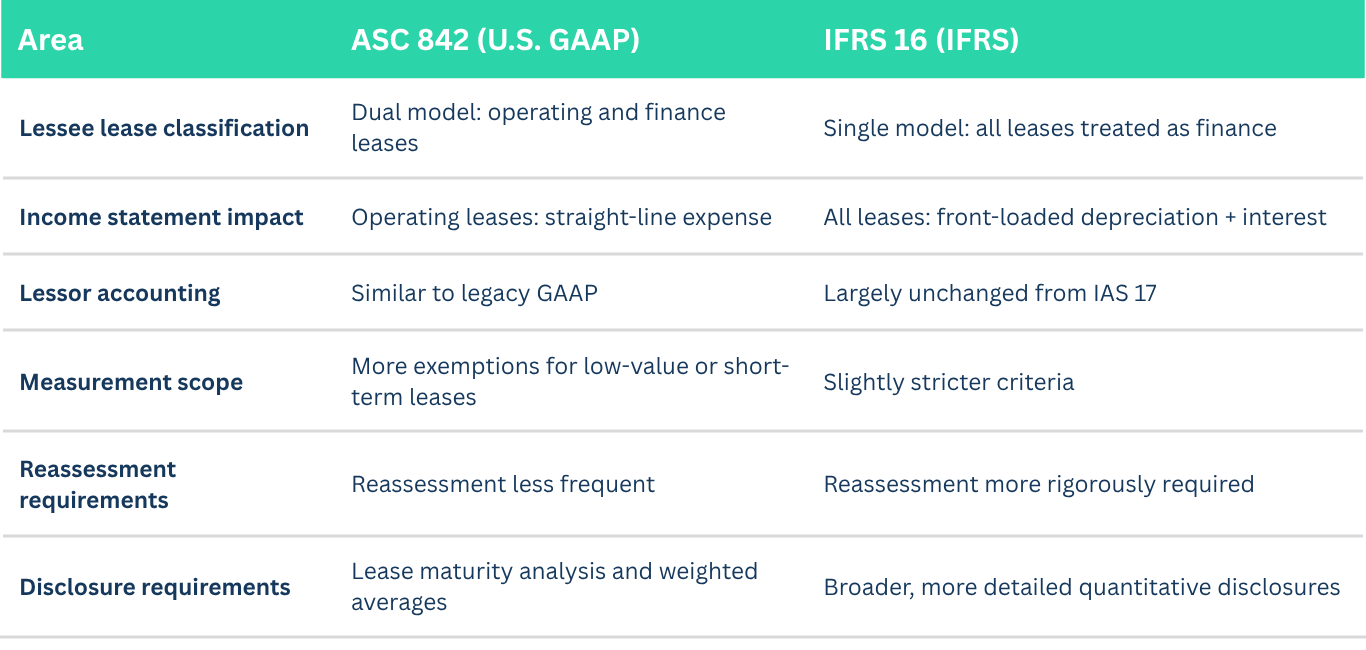
Why a global perspective matters for U.S. companies |
💡U.S. companies operating globally – or planning to expand – should therefore consider software solutions like Envoria that offer multi-GAAP capabilities to manage leases across borders efficiently and reduce the risk of inconsistencies. |
|---|
Confidently master ASC 842: From compliance to strategic advantage
Navigating ASC 842 is no longer just about ticking boxes — it’s about transforming lease accounting into a streamlined, transparent, and strategic process. As lease portfolios grow in complexity and audit expectations rise, companies that rely on manual processes risk costly errors and inefficiencies.
By embracing automated lease accounting solutions, finance teams can reduce manual errors and free up resources for higher-value tasks, ensure audit readiness with complete documentation and transparent calculations, simplify multi-entity and multi-standard reporting, including ASC 842, IFRS 16, and beyond, and gain real-time insights into lease liabilities that inform better business decisions.
In today’s competitive landscape, ASC 842 compliance can become a driver of operational excellence and financial clarity, not just a regulatory burden. Leveraging modern software like Envoria that supports both U.S. GAAP and international standards is key to unlocking this potential.
Looking for a solution that supports ASC 842 and global standards in one platform? Envoria’s Lease Accounting software helps companies automate lease accounting under ASC 842 and ensure compliance across all major frameworks. Book your demo today! |
|---|