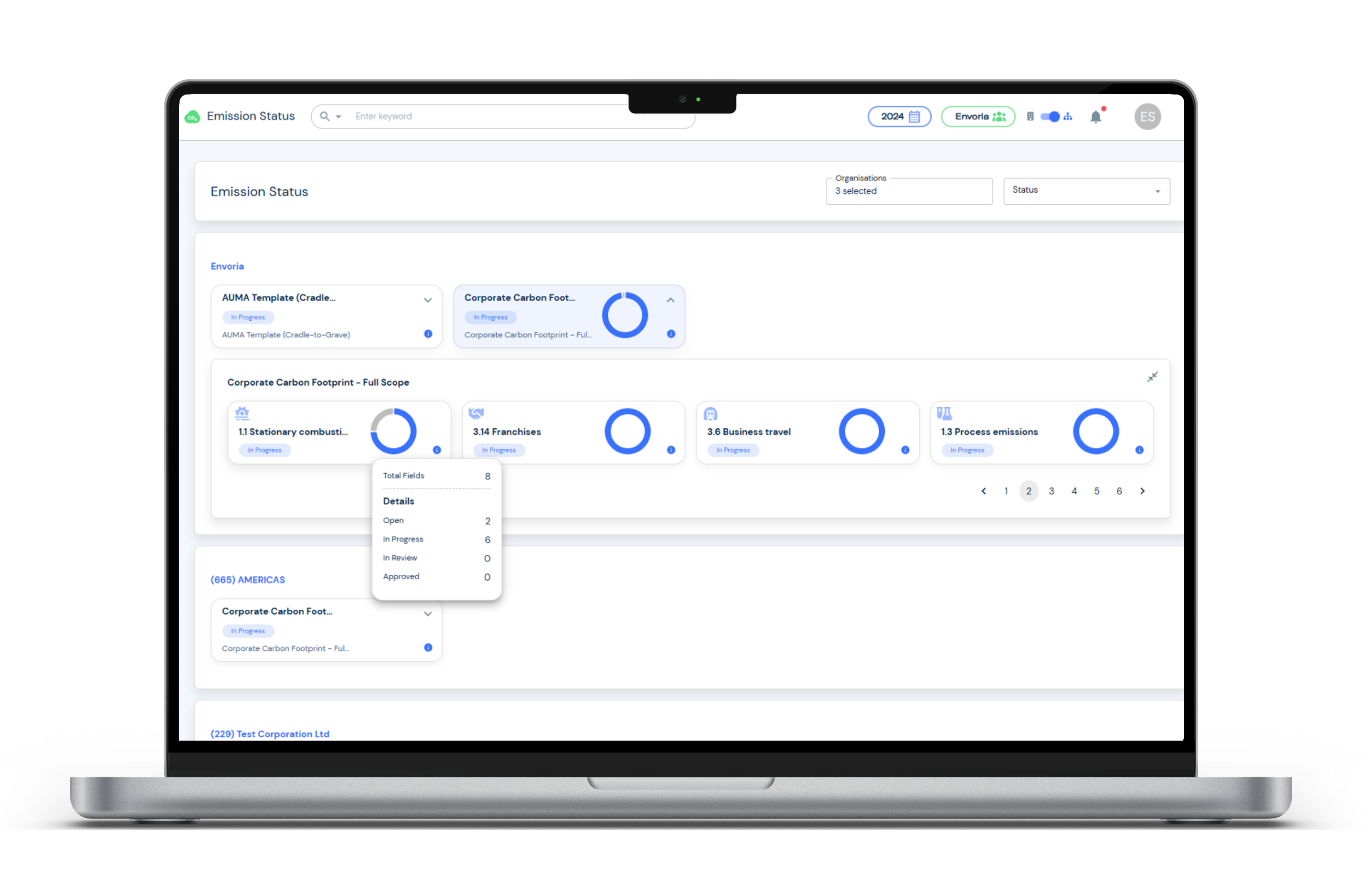
Collect quantitative data for all identified emission sources in a centralized system. Standardize data collection across entities, enable collaborative workflows across teams, and ensure consistent data quality throughout your emissions processes. Create a reliable foundation for carbon footprint calculation, analysis, and reporting.
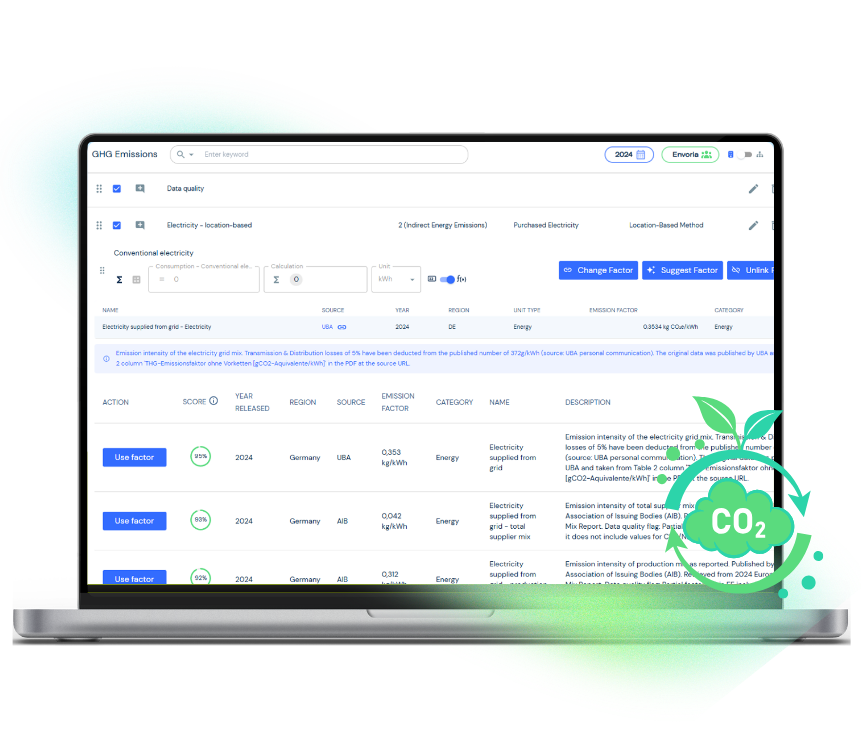
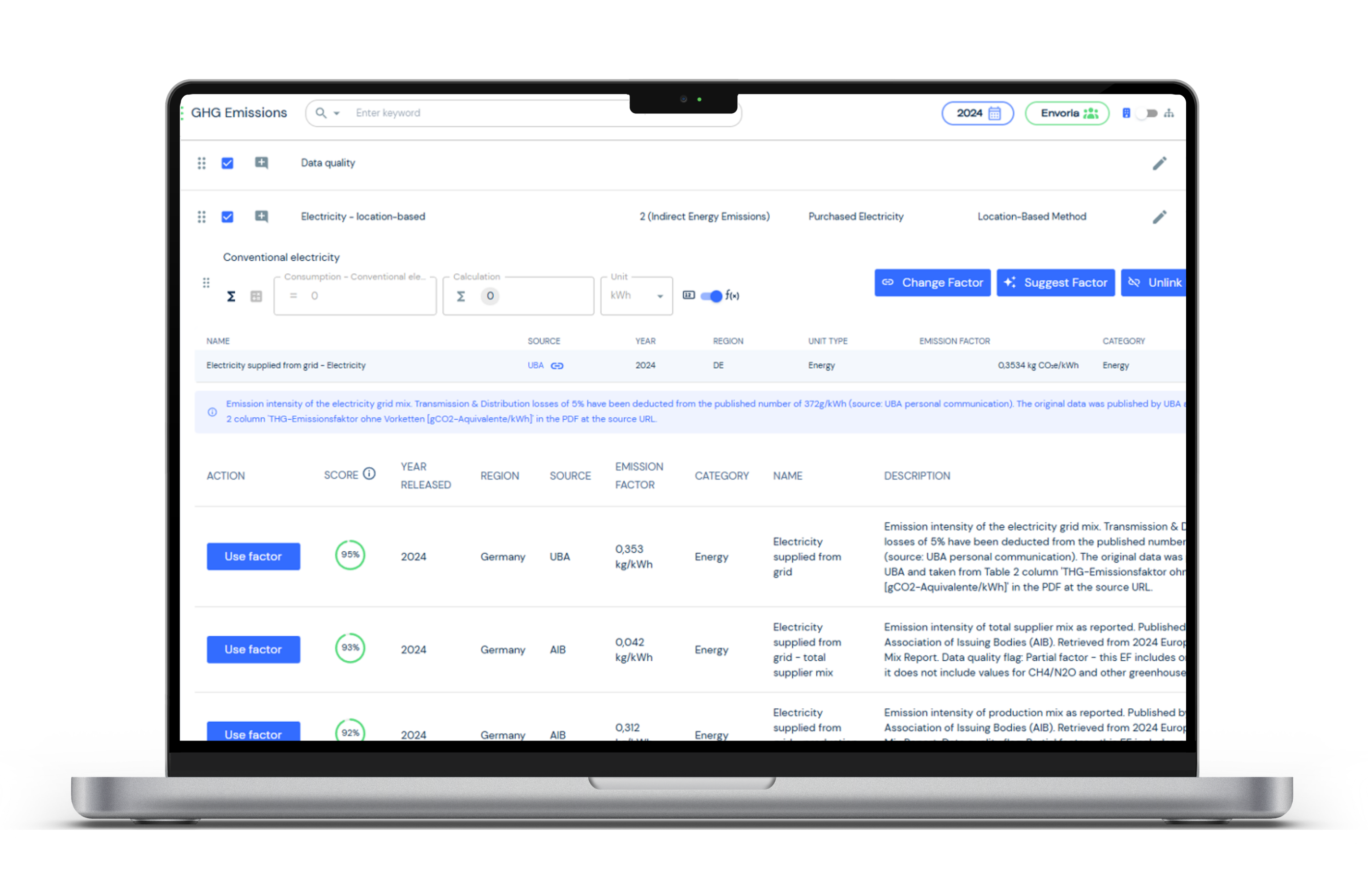
Use standard emissions factors from DEFRA, EPA, or IPCC to convert your activity data to CO2 equivalents (CO₂e). After, automate your CO2 footprint calculations using established protocols, such as the GHG Protocol.
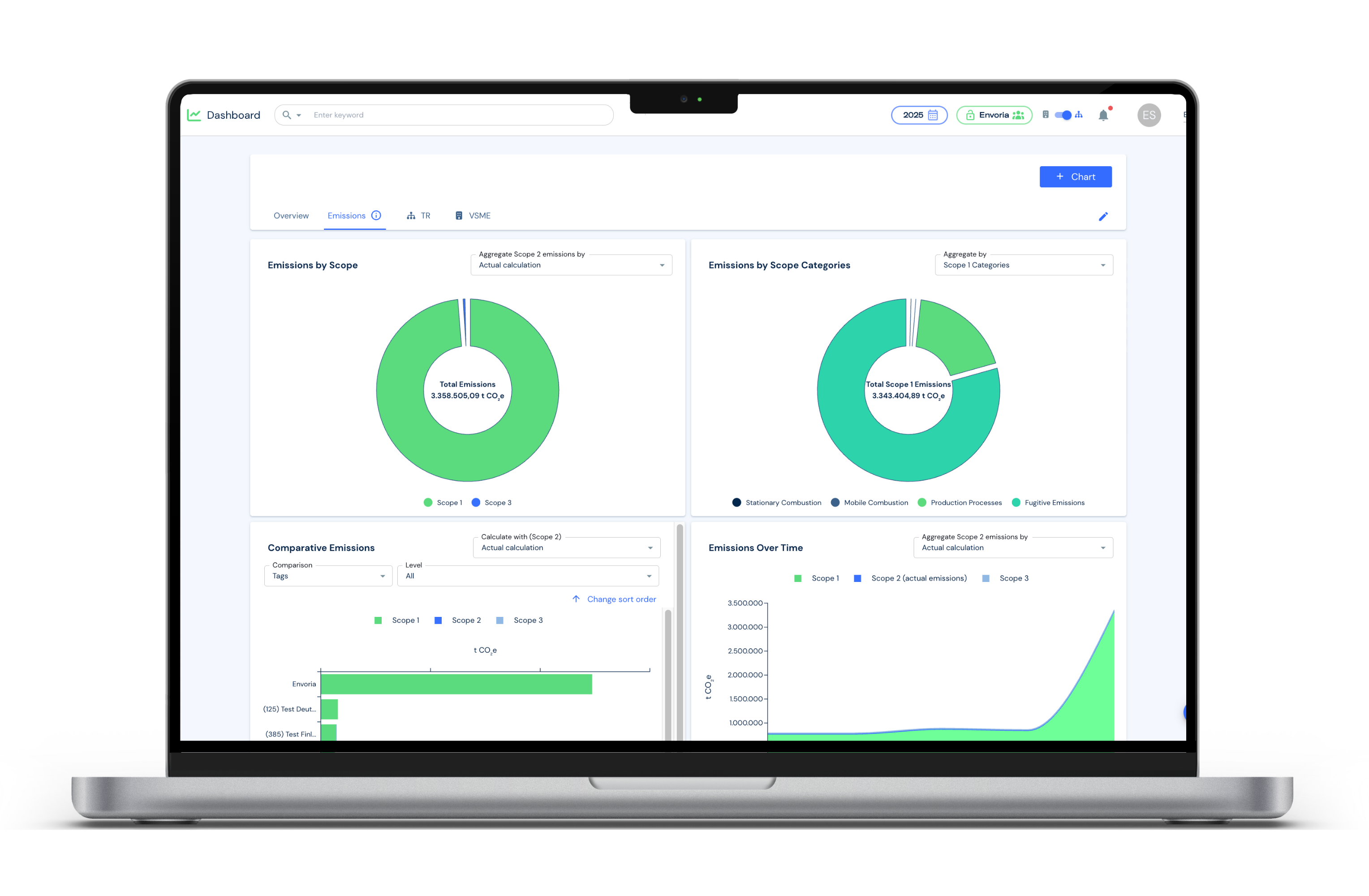
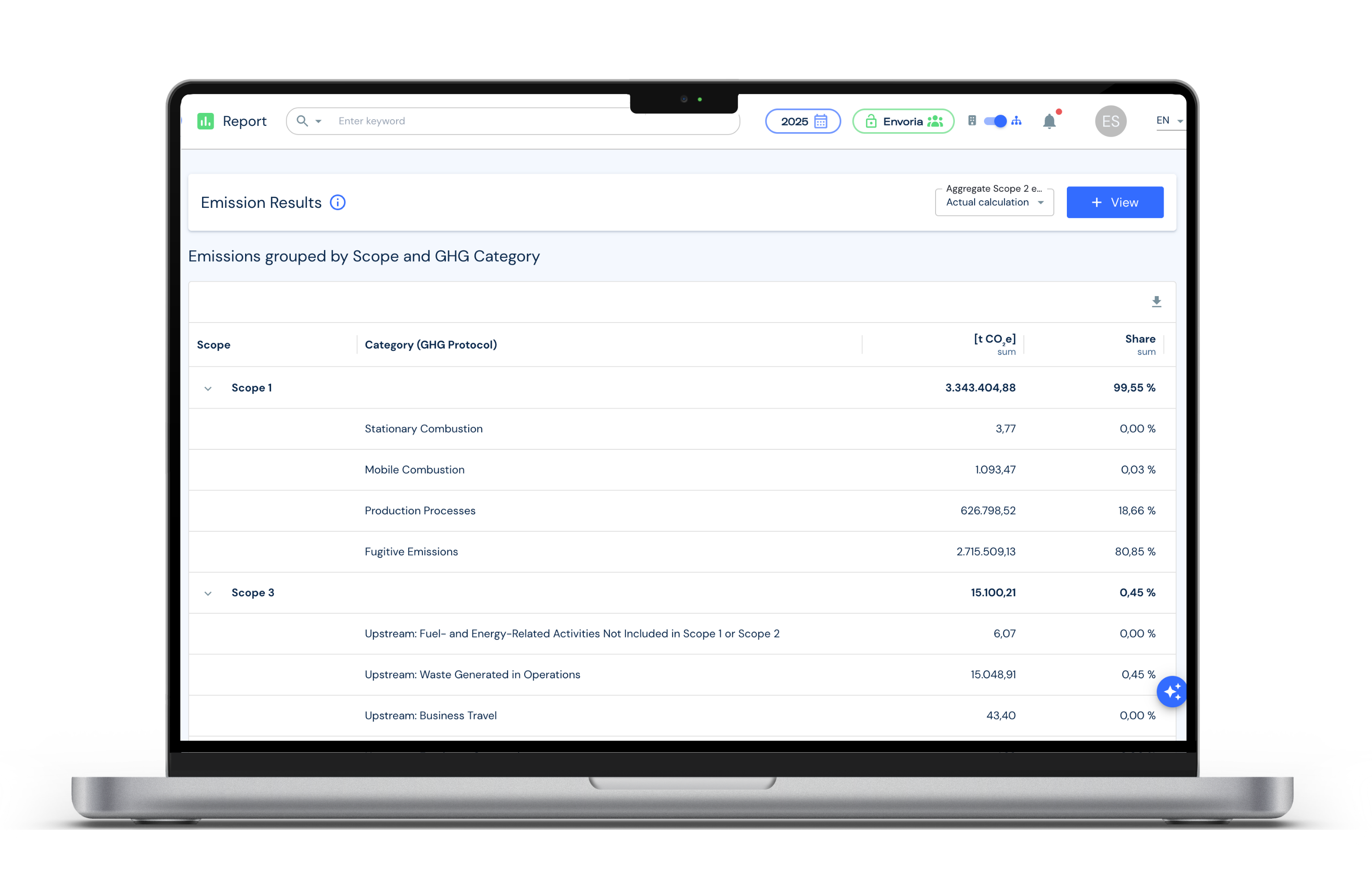
Gain detailed insights into your emission calculation results and identify the key drivers and hotspots across your footprint.
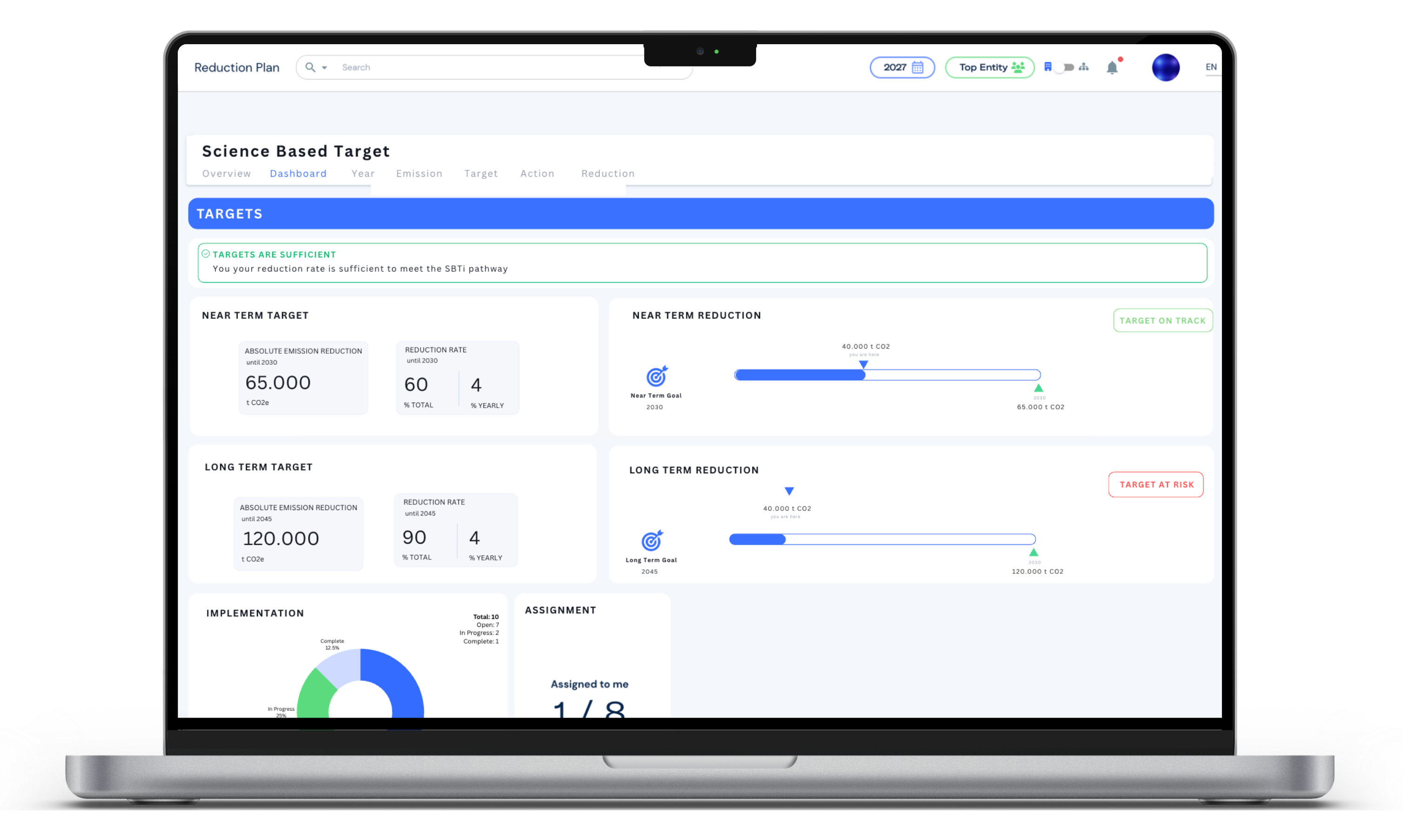
Define SBTi-based climate targets and manage your emissions reduction along structured decarbonization pathways. Track target achievement, progress, and reduction measures centrally in Envoria.
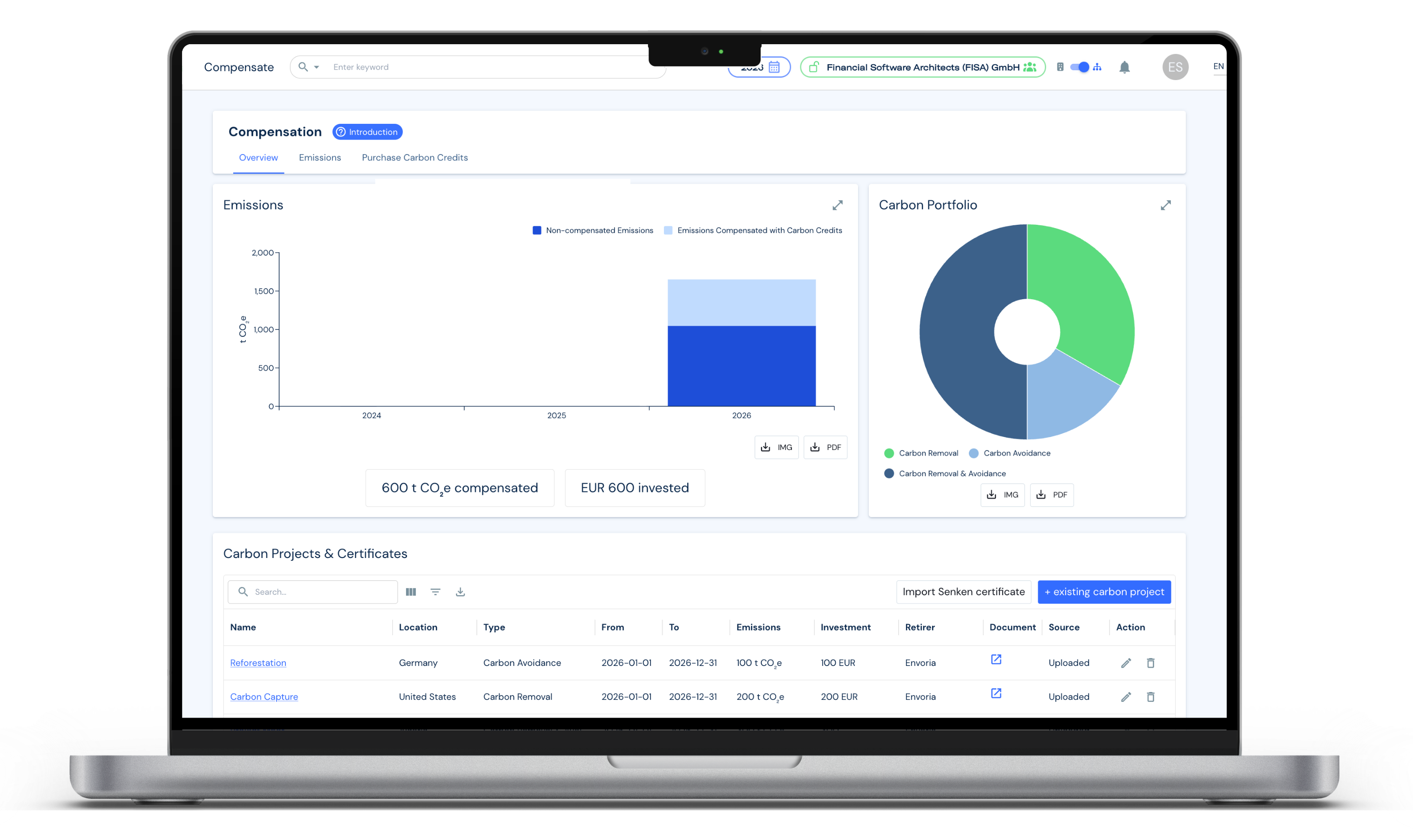
Compensate for your remaining emissions quickly and easily by purchasing carbon credits directly via the Envoria platform, and manage your climate projects and certificates transparently and centrally in Envoria.
Effortlessly create comprehensive carbon footprint reports to communicate your emissions data and sustainability efforts, inform stakeholders, and meet regulatory requirements.
Envoria's upcoming features for emission management will take you further: improve consistency, speed, and transparency across your carbon footprint workflows.
Plan and track emissions reductions based on standardized XDC transformation pathways for structured decarbonization strategies.
Develop individual reduction pathways based on your company goals, emissions data, and decarbonization measures.
Use intelligent AI-powered Product Carbon Footprint (PCF) calculations to automate the calculation of product-related emissions.
New improvements for more efficient emissions processes, including optimized live templates and automated updates of emission factors.
Designed to simplify your CO2 reporting processes.
Navigate your emissions management with built-in guidance and get instant help from Envoria AI assistant EVA directly in the Envoria platform.
Validate and harmonize emissions data directly during data entry with built-in checks, conversion factors, comments, and task management.
Envoria features stored formulas to simplify your CO2 footprint calculations, making it easy to to calculate all your data points and improve emissions tracking.
The software includes a carbon footprint template witin the GHG emissions area, allowing you to efficiently record your key figures and emissions data.
Envoria’s CO2 balance integrates GHG Protocol calculation methods, offering a reliable approach for emissions tracking and carbon footprint analysis.
Customize your emission factors, categories, sources, templates, methods, and CO2 balances for capturing GHGs, ensuring alignment with your needs.
You can directly access up to 500,000 emissions factors via the Envoria software and different interfaces, eliminating the hassle of tedious data gathering.
AI automatically maps activity data to the most suitable emission factors and categories, reducing manual effort while improving consistency and calculation quality.
Envoria offers a clear visual overview of emissions, categorized by scope and percentage shares of total emissions for effective carbon management.
Plan and track SBTi-compliant emissions reductions over multiple years. Define climate targets and monitor the progress of your decarbonization centrally in Envoria.
Manage climate projects and certificates, purchase carbon credits directly through the Envoria platform, and keep all compensated emissions transparently in view.
The Emissions Management and ESG Reporting (CSRD/ESRS) modules can be linked. This means that emission values only need to be determined once.




Envoria enables companies to perform a comprehensive and standards-compliant calculation of their Corporate Carbon Footprint (CCF). The software is aligned with the Greenhouse Gas (GHG) Protocol and provides a dedicated CCF template feature for the systematic collection of relevant emission sources and data points. This ensures a structured and transparent approach to carbon accounting. By integrating predefined calculation formulas and offering access to an extensive emissions factor database containing up to 500,000 entries, Envoria significantly streamlines the CO₂ accounting process. Additionally, built-in guidance documents support users throughout each step of the emissions reporting workflow.
The Product Carbon Footprint (PCF) can currently be captured in a simplified format within Envoria. This allows companies to record initial product-level emissions data for internal analyses or voluntary disclosures. An enhanced PCF functionality is already under development.
Envoria enables precise and customizable recording of emission data at company, site, and process level. The software offers a wide range of configuration and customization options, allowing emission categories, sources, calculation methods, and templates to be tailored to the specific organizational structure.
Integrated CCF templates facilitate the efficient documentation of greenhouse gas emissions and their direct allocation to the appropriate Scopes. Reporting is carried out in accordance with the standards of the Greenhouse Gas (GHG) Protocol, ensuring a standardized and auditable data foundation. Stored formulas linked to embedded emission factors support the consistent and accurate calculation of emissions.
In addition, activity data required for emission calculations can be integrated via various interfaces and import functions, allowing for a high degree of flexibility in data management and analysis. The software also provides practical guides and step-by-step instructions to support users throughout the entire data collection process in a clear and efficient manner.
Scope 3 emissions are among the most complex aspects of emissions reporting, as they encompass all indirect emissions across the value chain. Envoria supports a structured and detailed approach to capturing Scope 3 emissions in alignment with the 15 categories defined by the Greenhouse Gas (GHG) Protocol. Companies can input their own activity data, incorporate external sources, or import data from other systems via interfaces.
Up to 500,000 emission factors can be assigned to support the calculation process. Stored formulas ensure consistent and transparent emission calculations. All emission values can be recorded with Scope-specific attribution and are clearly visualized within the emissions dashboard.
In addition, Envoria enables multi-year management of Scope 3 data, including version history and audit trail functionality. This ensures traceability and data consistency across reporting periods.
Envoria enables companies to calculate, reduce, and compensate emissions within one integrated platform while also allowing organizations to use the three individual areas of the Emissions Management module separately based on their requirements.
For emissions reduction, Envoria supports SBTi-based reduction pathways. XDC reduction pathways and individual reduction plans tailored to company-specific climate targets and decarbonization strategies are currently under development. Organizations can define target years, manage reduction KPIs, monitor reduction progress across Scope 1, Scope 2, and Scope 3 emissions, and track planned and actual reductions over multiple reporting years.
In the area of climate compensation, Envoria enables organizations to manage compensated emissions and climate projects centrally within the platform. Based on calculated emissions data, companies can define annual compensation amounts and directly purchase Carbon Credits for selected climate projects through Envoria.
Climate compensation requests are processed through Envoria’s partner Senken, which validates the compensation volume and issues the corresponding certificates. Certificate data and climate project information are automatically synchronized back into Envoria, creating a transparent overview of compensated emissions, climate projects, certificates, and remaining emissions across reporting years.
This centralized approach allows companies to combine carbon accounting, emissions reduction, and climate compensation in one platform while maintaining full transparency across their decarbonization activities.
Yes – Envoria allows for multi-year management and structured historical tracking of emission data. Companies can define various reporting periods and obligations tailored to specific countries, sites, or corporate structures. The software provides comprehensive version control and full traceability of all data changes, ensuring that emissions data remain available for audits, reviews, and performance comparisons over time.
The integrated emissions dashboard offers a wide range of analysis options, such as comparing emissions by Scope or organizational unit. Custom charts and evaluations can be created flexibly to meet individual reporting needs.
A planned extension will introduce a reduction planning module, enabling users to define reduction targets and manage mitigation measures systematically. Even now, reports and analyses can be tailored to different reporting frameworks and standards, such as CSRD, ESRS, or voluntary sustainability disclosures.