You have the choice: We offer two powerful ways to better understand your climate risks, make informed decisions, and make your risks transparent and measurable.
Without software
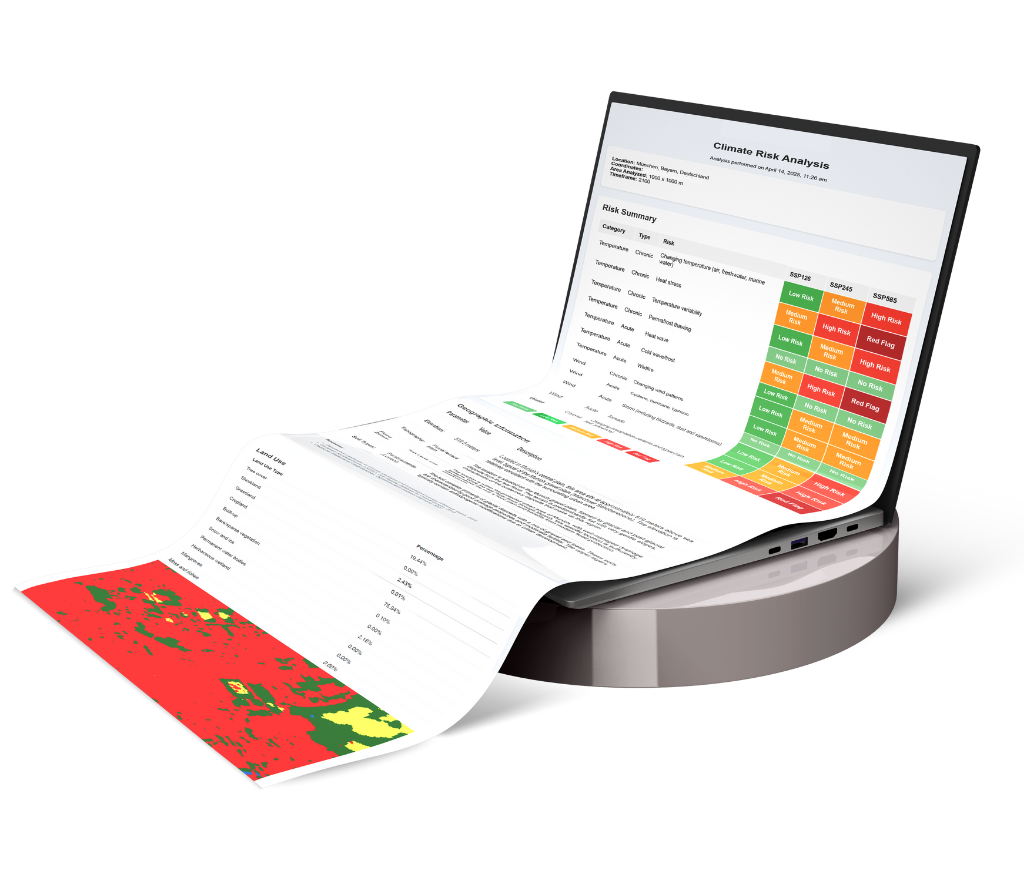
Order precise climate risk analyses, from a single report up to 10,000+ at once. Each detailed PDF report (approx. 45 pages) provides reliable data on physical risks based on the latest SSP scenarios, including risk ratios, exact location (address/GPS), scenario choice, time period, and source references. This gives you a solid, audited basis for decision-making – with no Envoria software license required.
With software
Use Envoria’s climate risk analysis tool and import your analysis results directly into the Envoria software. Benefit from advanced features for detailed evaluation, visualization, and integration of your climate risks into your ESG strategy. Optimize your risk management flexibly, securely, and future-proof – tailored to your individual needs.
Start your analysis by specifying the locations and parameters relevant to your climate risk assessment. This step sets the foundation for a targeted evaluation.
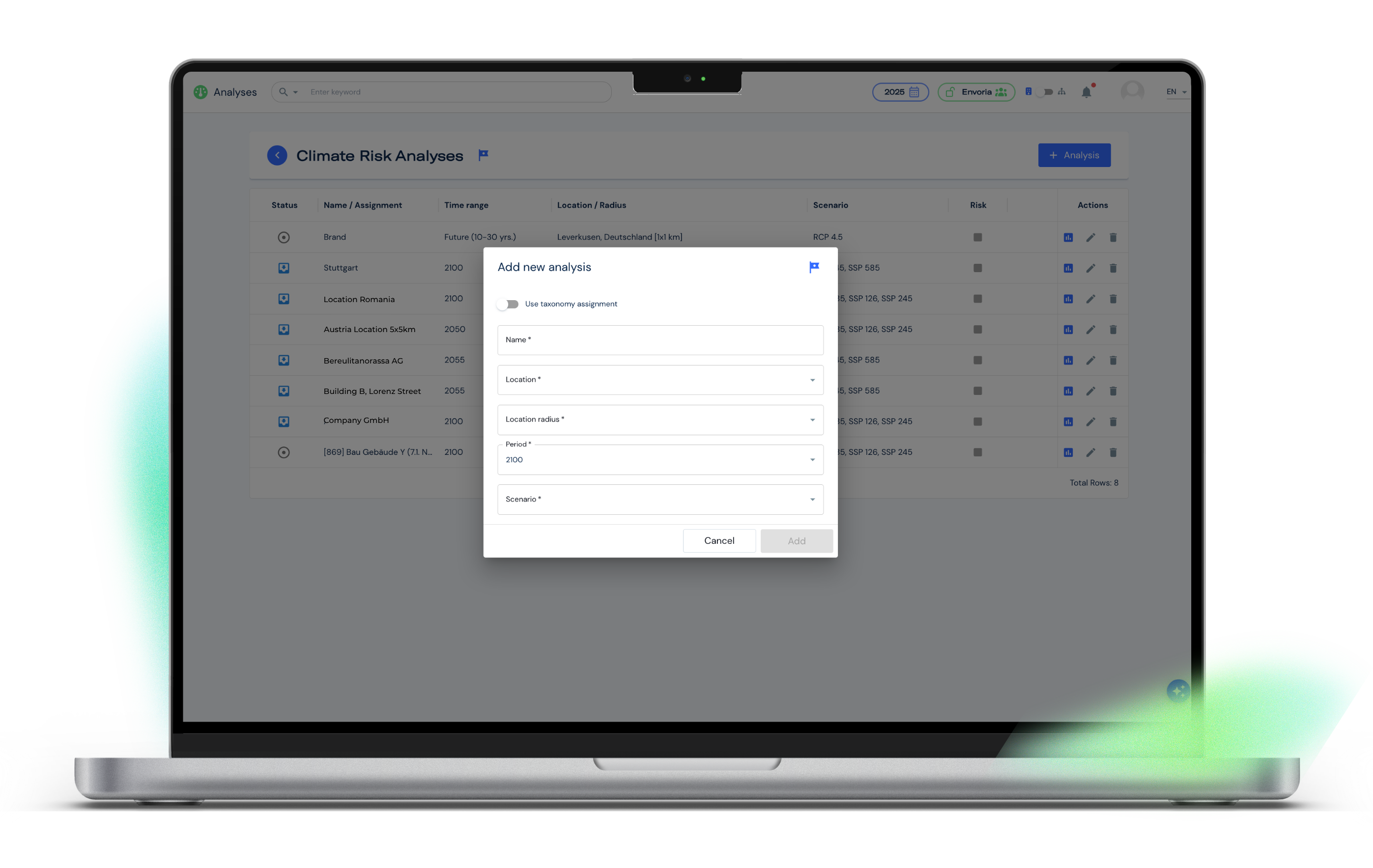
Leverage our climate risk analysis software to automatically generate initial risk scores for your selected locations. The AI-based analysis is grounded in scientifically validated climate scenarios that integrate the IPCC’s SSP and RCP models, ensuring realistic and comparable evaluations of future climate and emission trends.
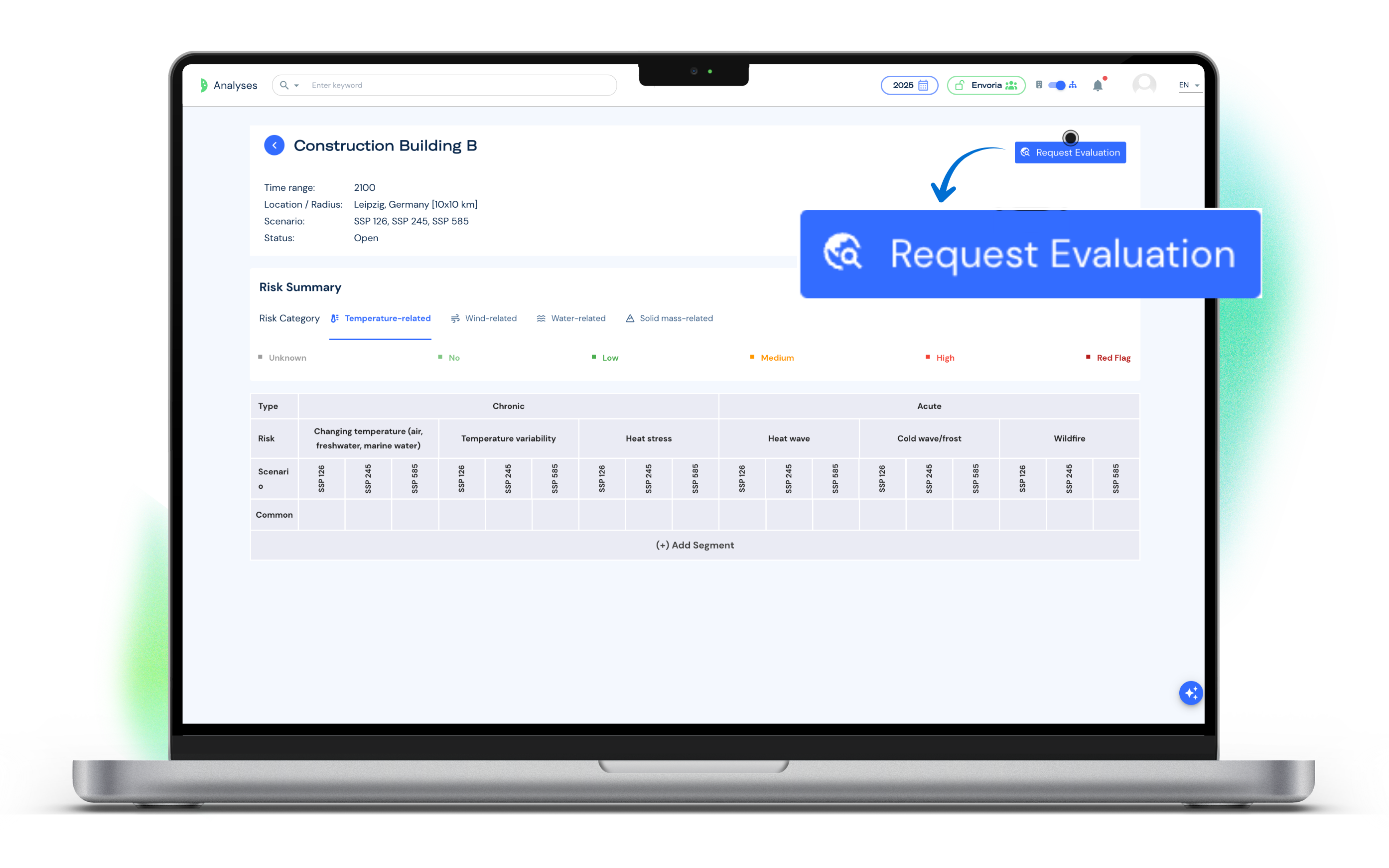
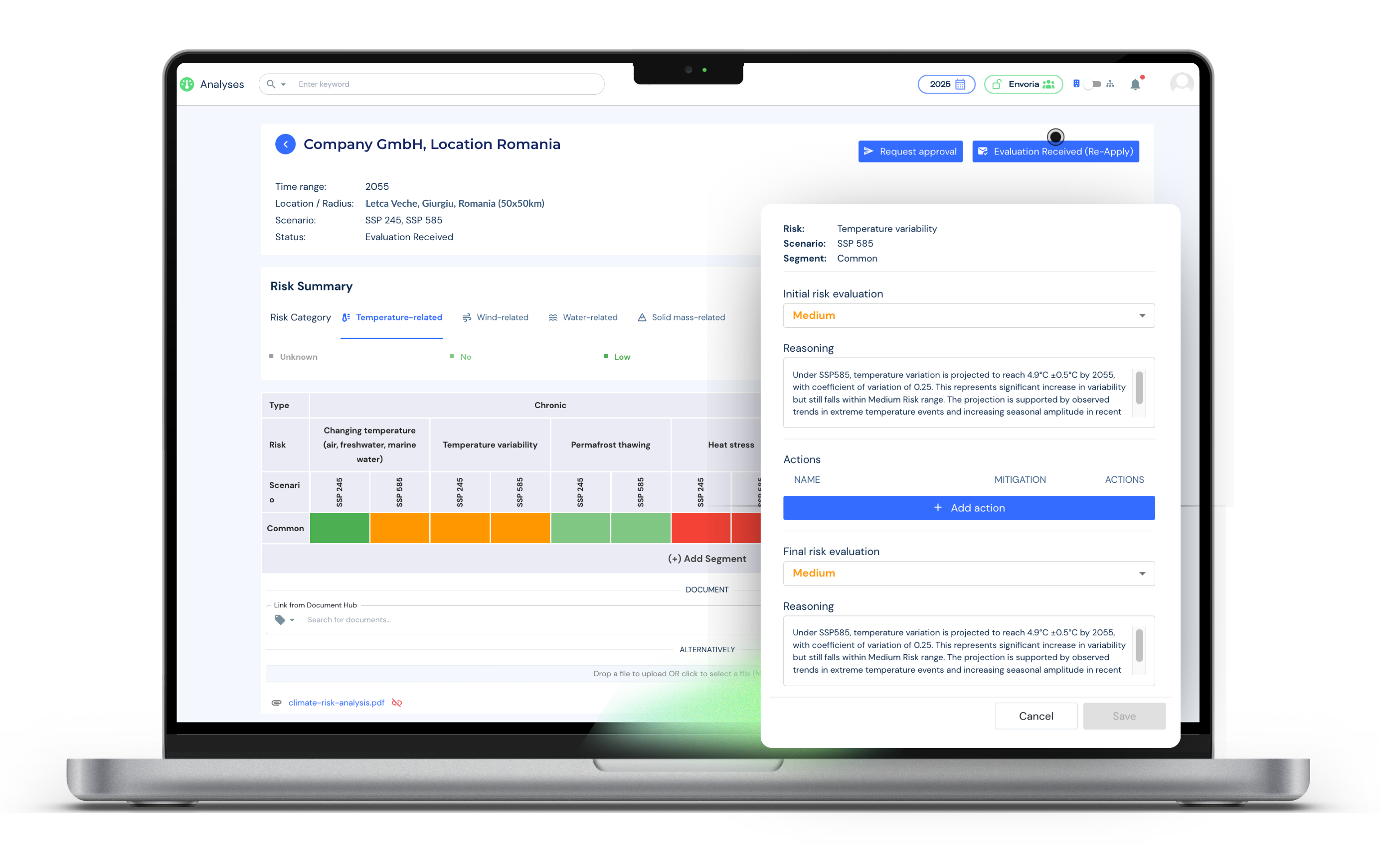
Use our risk matrix to clearly visualize your identified risks. Quickly assess and categorize the urgency of each risk, allowing you to act on high-priority threats.
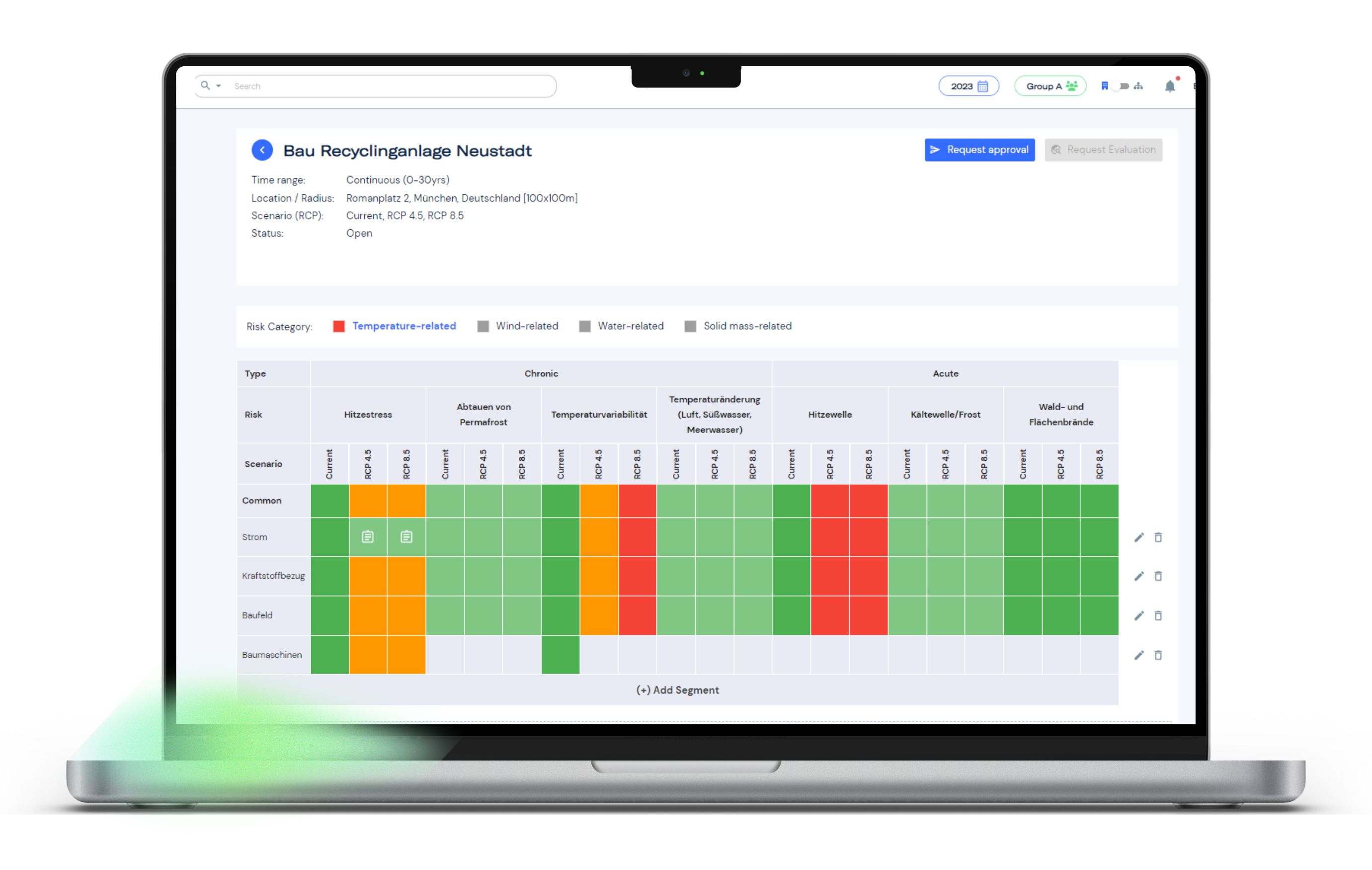
Assess your climate risks holistically or segment them into specific categories to gain deeper insights into individual risk areas. This approach enables you to identify risks precisely and manage them effectively.
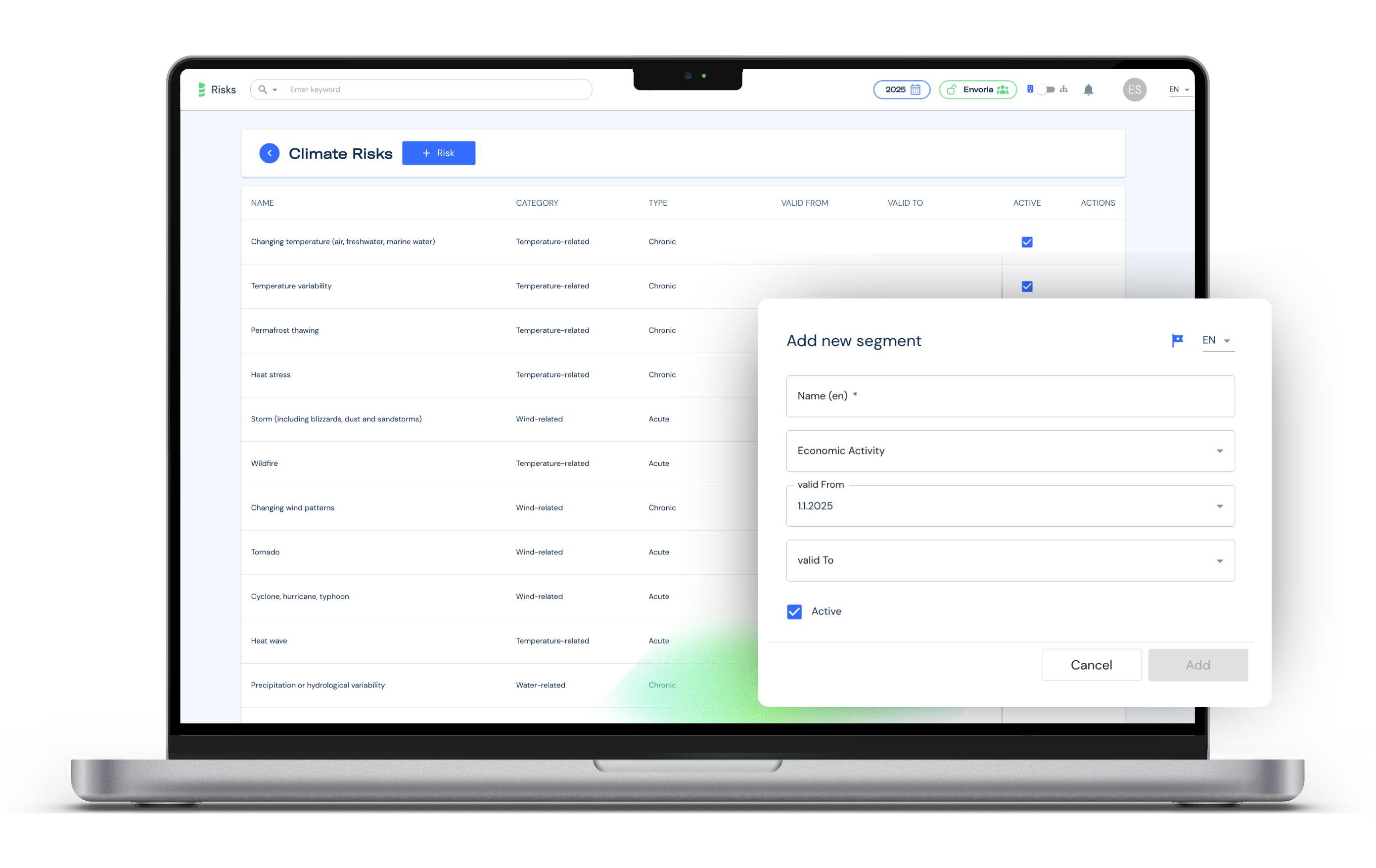
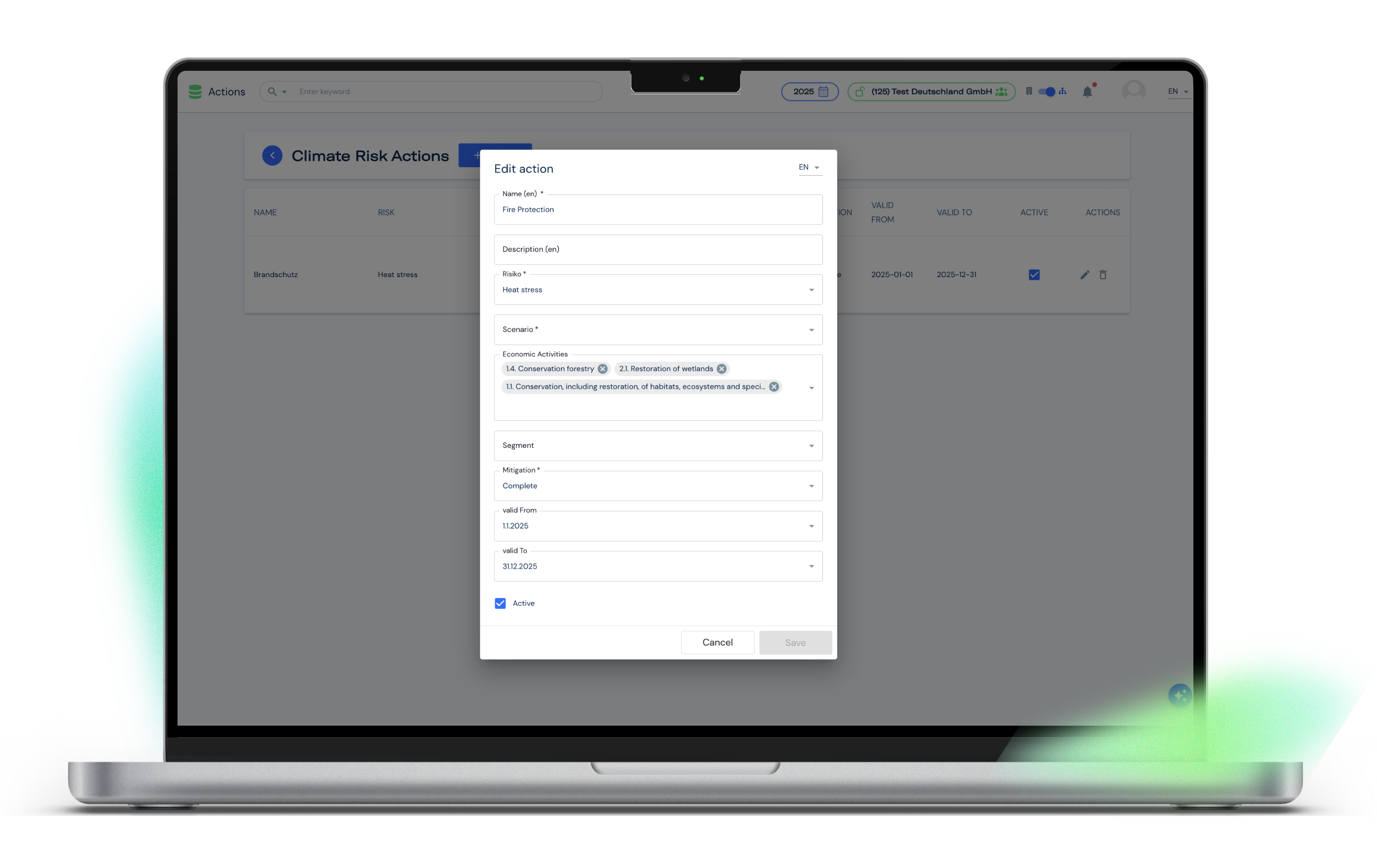
Identify and document targeted mitigation measures to reduce climate-related risks. This step ensures you have a proactive approach to managing climate impacts.
Compile all required documentation and evidence to support your final climate risk assessment. This ensures your climate risk analysis is robust, transparent, and audit-ready.
Designed to simplify your climate risk assessment processes.
The integrated climate risk analyses guidelines within the software ensure a smooth assessment process, helping you navigate each step effectively.
Start an automatic climate risk assessment in Envoria with just one click, based on IPCC climate scenarios. The results are available within your Envoria instance.
Effortlessly assess climate risks with our automated scoring. Instantly generate initial risk scores for each of your locations, covering 28 distinct hazard types.
Get a clear overview with Envoria’s visual risk matrix that allows you to view your climate risks categorized by urgency, from "No Risk" to "Red Flag".
Envoria’s module features allow you to segment climate risks for deeper insights and define targeted actions to mitigate each identified risk.
Align climate risk analyses with specific EU Taxonomy activities by using the taxonomy assignment option when creating a new assessment.
Conduct 10,000+ climate risk analyses at the same time. The exact number depends on your contract terms. Additional analyses are available as add-ons.
Integrate key insights from your climate risk analysis into CSRD reporting, particularly for materiality analysis and ESRS E1 compliance.






Envoria’s climate risk assessment module is a scalable solution suitable for organizations of all sizes – from mid-sized enterprises to multinational corporations. It is specifically developed to accommodate diverse corporate structures, industry-specific requirements, and evolving regulatory frameworks. For large-scale projects, the software supports the parallel execution of over 10,000 climate risk analyses.
Applicable across sectors such as manufacturing, financial services, and global supply chains, the module enables the identification, assessment, and evaluation of both physical and transition climate risks in an organization-specific context. Its flexible architecture allows for precise data collection and analysis at both the entity and consolidated group level, making it well-suited to complex organizational and project structures.
The AI-based climate risk assessment module supports organizations in systematically identifying and assessing climate-related risks. It takes into account both physical risks (e.g., heatwaves, floods) and transition risks (e.g., carbon pricing, regulatory changes).
The risk assessment is based on scientifically grounded climate scenarios, typically derived from IPCC models. Emission pathways (e.g., SSP1-2.6 to SSP5-8.5) and corresponding temperature trajectories (+1.5°C, +2°C, +4°C) are used to evaluate impacts in a temporally and contextually differentiated manner. By integrating geospatial information systems (GIS), climate databases, and thousands of regional sources (e.g., local environmental agencies), the software enables detailed analysis of localized risk profiles and impacts for individual assets, production sites, or project locations. Risks can vary significantly even within a city or region due to factors such as microclimates, topography, or surface sealing.
Additionally, Envoria’s climate risk analysis tool supports multiple time horizons – short-, medium-, and long-term – up to the year 2100. A unique feature is the ability for organizations to define the end year of their climate risk analysis scenarios according to their specific needs.
Envoria’s climate risk analysis tool helps organizations create effective adaptation actions and resilience plans based on the risks identified. An AI-powered feature analyzes large amounts of scientific data, interprets the results, and identifies specific risks related to activities like building construction or certain investments.
Based on this, the tool automatically provides initial mitigation measures and actionable recommendations, which can be customized to the organization’s needs. These proposals help address vulnerabilities in operational processes, supply chains, and investment strategies, allowing organizations to simulate different scenarios and make informed decisions to secure their future resilience.
The climate risk assessment module of Envoria software not only helps organizations systematically identify and assess climate-related risks but also supports reporting in accordance with regulatory requirements such as the ESRS (European Sustainability Reporting Standards), the EU Taxonomy, and the recommendations of the TCFD (Task Force on Climate-related Financial Disclosures).
Climate risk analysis results can easily be integrated into Envoria’s EU Taxonomy and ESG reporting module — for example, to support CSRD and ESRS E1-compliant reporting.
The software is regularly updated to keep pace with changing regulations, helping organizations stay compliant and confidently meet future reporting requirements, including CSRD obligations.
Envoria allows organizations to tailor their climate risk analyses to specific requirements – for instance, by selecting the analysis timeframe (up to the year 2100) and defining the spatial scope (from 100 × 100 meters up to 100 × 100 kilometers). The platform also offers the flexibility to adjust risk factors within scenario outcomes, ranging from low to high risk, enabling precise consideration of industry-specific and regional nuances.
The climate risk analysis software includes comprehensive visualization tools. Utilizing a range of maps, heatmaps, result tables, and charts, it presents complex climate risks and their potential impacts in a clear and accessible manner, supporting both operational decision-making and strategic management. These visual insights also enhance transparency for external stakeholders, such as investors and regulatory bodies, by delivering straightforward and actionable risk information.
The software enables seamless integration into existing IT infrastructures via APIs. This creates a tailored solution that efficiently supports both risk management requirements and ESG reporting needs.