In many companies, the evaluation of ESG tools initially focuses on the cost of ESG software. License fees, implementation effort, and internal resources are usually the main considerations. The actual economic impact, however, is often underestimated or assessed only qualitatively.
For mid-sized companies in particular, this perspective is crucial. ESG processes are often managed alongside day-to-day business, manual effort is high, and structures are not yet fully established. As a result, hidden costs arise that are not immediately visible in traditional budget planning.
A concrete cost-benefit calculation helps make these effects tangible and supports well-founded decision-making.
Initial situation: ESG reporting with Excel and manual processes
In many mid-sized companies, ESG reporting has developed organically over time and is based on Excel, individual data requests, and manual coordination processes. This approach works in the early stages, but as requirements increase, it leads to growing complexity.
In this example, we look at a typical industrial company:
- approx. 250 employees
- approx. €50 million in annual revenue
- no systematic ESG reporting, but Excel-based processes
- manual data collection and coordination between departments
ESG reporting takes place twice a year and involves considerable organizational effort.
Operational effort without ESG software
The actual effort required for ESG reporting is underestimated in many mid-sized companies because it is spread across several areas and not recorded centrally.
In the example shown, the situation is as follows: one central person responsible for ESG spends around 50% of their time on reporting. In addition, several specialist departments regularly provide data and are involved in coordination processes. Each reporting period creates additional hours for data collection, coordination, and corrections:
- 0.5 ESG FTE: 50% of working time for ESG reporting (€80,000/year)
- 4 specialist departments: approx. 20 hours each per reporting period (160 hours/year; €60/hour)
Typical problems caused by manual processes are added on top:
- High error rate: rework and coordination cause an additional 20% effort
- Lack of transparency makes audits more difficult: external auditors require an additional 40 hours/year (€100/hour)
This creates a considerable overall effort that is often not fully visible, but still results in real costs.
Investment in ESG software: cost structure at a glance
Introducing ESG software involves not only ongoing annual license costs, but also one-time expenses for implementation and training.
In the example shown, the cost basis is as follows:
- License and usage costs: approx. €12,000 per year for 4 ESG modules
- Implementation and training: approx. €10,000 one-time cost
To classify the costs realistically, the one-time implementation costs are spread over several years. Assuming a usage period of three years, this results in an annual share of around €3,300.
This results in total costs of approx. €15,300 per year.
|
Important: The actual costs may vary depending on the scope of the project. In particular, more complex requirements or individual integrations can increase the initial effort, while simpler setups may also be possible with lower implementation effort. |
|---|
ESG software in day-to-day operations
Introducing ESG software digitizes existing processes within the company. At the same time, it takes on another important role: it structures processes. In the example shown, implementing ESG software leads to several changes in day-to-day operations:
- ESG data is collected centrally and no longer needs to be consolidated manually
- Standardized inputs and validations reduce errors and rework
- Coordination processes between departments are clearly defined and become more efficient
- Audit-relevant data is documented in a structured way and available at any time
The greatest impact does not come from individual functions, but from the combination of structure, automation, and transparency.
Savings potential through ESG software in mid-sized companies
Introducing ESG software affects not only individual process steps, but changes the entire way mid-sized companies handle ESG data. This becomes particularly clear in recurring tasks such as data collection, coordination, and reporting, which can be made significantly more efficient through structured processes and automation.
These structural improvements have a direct impact on operational effort and can often be quantified:
- Reduction of manual effort through automated data collection, centralized data storage, and standardized reporting processes
- Fewer errors and less rework through integrated validations and plausibility checks
- More efficient audits through traceable documentation, clear data origin, and structured audit processes
- Faster reporting cycles, which not only save time but also allow data to be used earlier for decision-making
In practice, many of these effects result from the interaction of structure, automation, and clearly defined processes. Especially in mid-sized companies, even smaller efficiency gains, such as fewer coordination loops or reduced manual data collection, can have a noticeable economic impact. These effects can often be translated directly into saved working time and the associated cost savings.
Quantifiable savings potential at a glance
To make the effects described above more tangible, it is useful to look at the savings potential based on typical company processes. Reduced effort is translated into time and costs to provide a realistic economic assessment.
The following overview shows an example of how the described effects can translate into annual savings, for example through reduced manual effort, lower error rates, and more efficient audit processes.
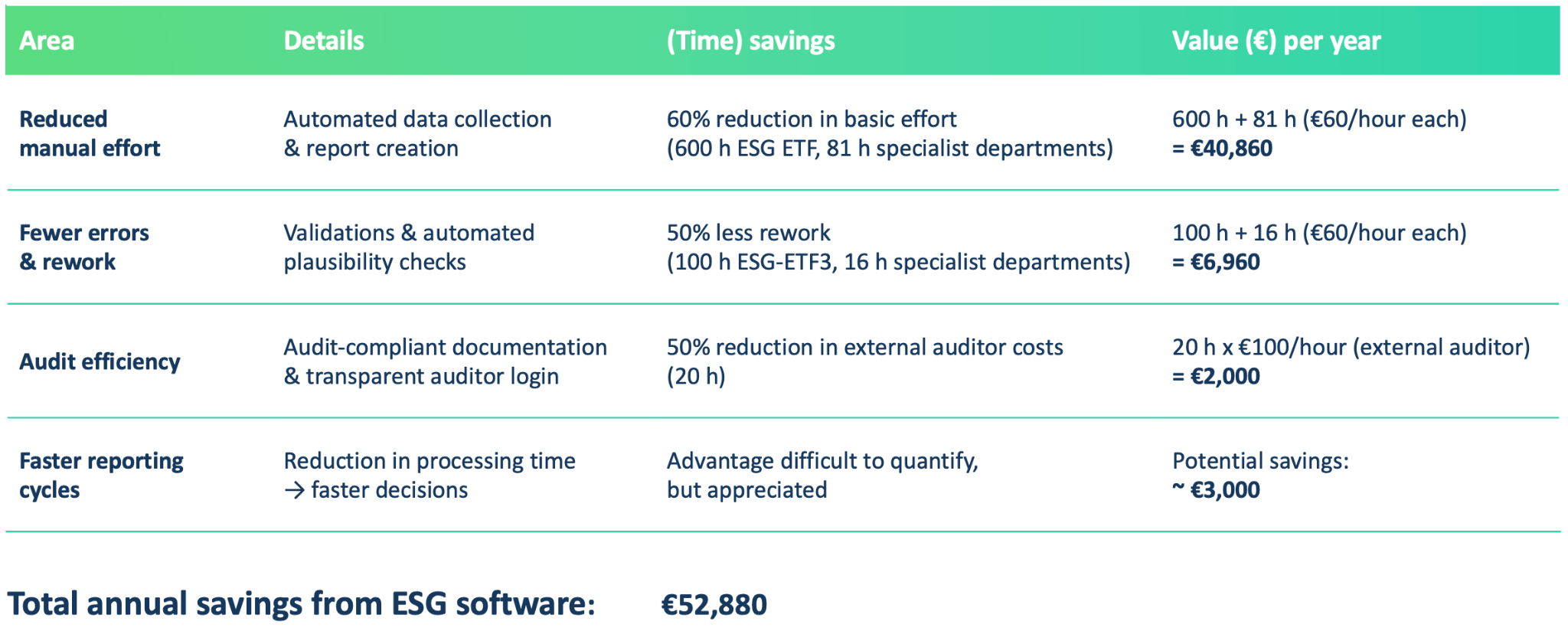
The overview shows that reducing manual tasks and improving data quality have a direct financial impact. It also becomes clear that several smaller effects can add up to significant savings potential. The decisive factor is not one single lever, but the combination of multiple improvements along the entire ESG process.
Result: clear economic viability despite additional ESG software costs
In the example shown, annual savings amount to more than €50,000, while the total annual costs of the ESG software, including the prorated implementation costs, are around €15,000. This results in an annual net benefit of more than €35,000.
This net effect shows that the economic benefit does not come only from individual efficiency gains, but from the sum of many operational improvements.
It is important to understand that the investment consists not only of license costs, but also includes initial setup, process definition, and training. These factors are crucial for the long-term success and actual efficiency of the solution.
This means:
- The investment pays for itself within a short period of time
- Operational effort is reduced sustainably
- Processes become more stable and scalable
In addition, there are qualitative benefits that cannot be fully captured in monetary terms, such as:
- Higher data quality
- Better basis for decision-making
-
Lower risk during audits
Conclusion: ESG software as an economic lever
The example shows that ESG software can be a clear lever for increasing efficiency and reducing costs in mid-sized companies. Especially in manual, Excel-based processes, hidden effort often arises that can be significantly reduced through structured ESG solutions.
It is therefore important not to view ESG software in isolation as a cost factor, but in the context of the entire process landscape and operational effort. Companies that take this perspective quickly recognize that investing in structured ESG processes pays off not only from a regulatory perspective, but also economically.
Note: The example calculation shown is based on typical project experience from the ESG software provider Envoria with mid-sized companies and is intended as guidance.