Companies seeking to enhance their environmental performance and document it in a structured manner will eventually encounter two key environmental management systems: ISO 14001 and EMAS. While both approaches pursue similar goals, they differ in structure, requirements, and scope.
This article compares the two systems, explains who they are relevant for, and shows how digital solutions can support their implementation.
What is ISO 14001?
ISO 14001 is an internationally recognized standard for environmental management systems (EMS). It defines the requirements for systematically improving environmental performance, ensuring legal compliance, and achieving environmental objectives. The standard is part of the ISO 14000 family and is applicable worldwide – regardless of company size, industry, or location.
Core elements of ISO 14001:
- Identification and assessment of environmental aspects
- Definition of environmental objectives and measures
- Compliance with legal and regulatory obligations
- Implementation of a continuous improvement process (PDCA cycle)
- Internal and external audits to verify effectiveness
Certification is voluntary and carried out by accredited bodies. In many industries, however, ISO 14001 is considered the benchmark for structured environmental management.
What is EMAS?
EMAS (Eco-Management and Audit Scheme) is a European environmental management system that builds upon ISO 14001 but includes additional requirements. Developed by the European Union, EMAS is aimed at organizations seeking to present their environmental performance in a transparent, credible, and verifiable manner.
Distinctive features of EMAS:
- Mandatory environmental statement, published on a regular basis
- External validation by licensed environmental verifiers
- Demonstrated continuous improvement of environmental performance
- Fulfillment of all ISO 14001 requirements plus additional reporting obligations
EMAS is primarily applied within Europe and is used by public authorities, municipalities, and companies that wish to maintain and document high environmental standards.
💡 Want to know more about EMAS? Read our article: What is the Eco-Management and Audit Scheme (EMAS)? |
|---|
Differences and similarities of ISO 14001 and EMAS
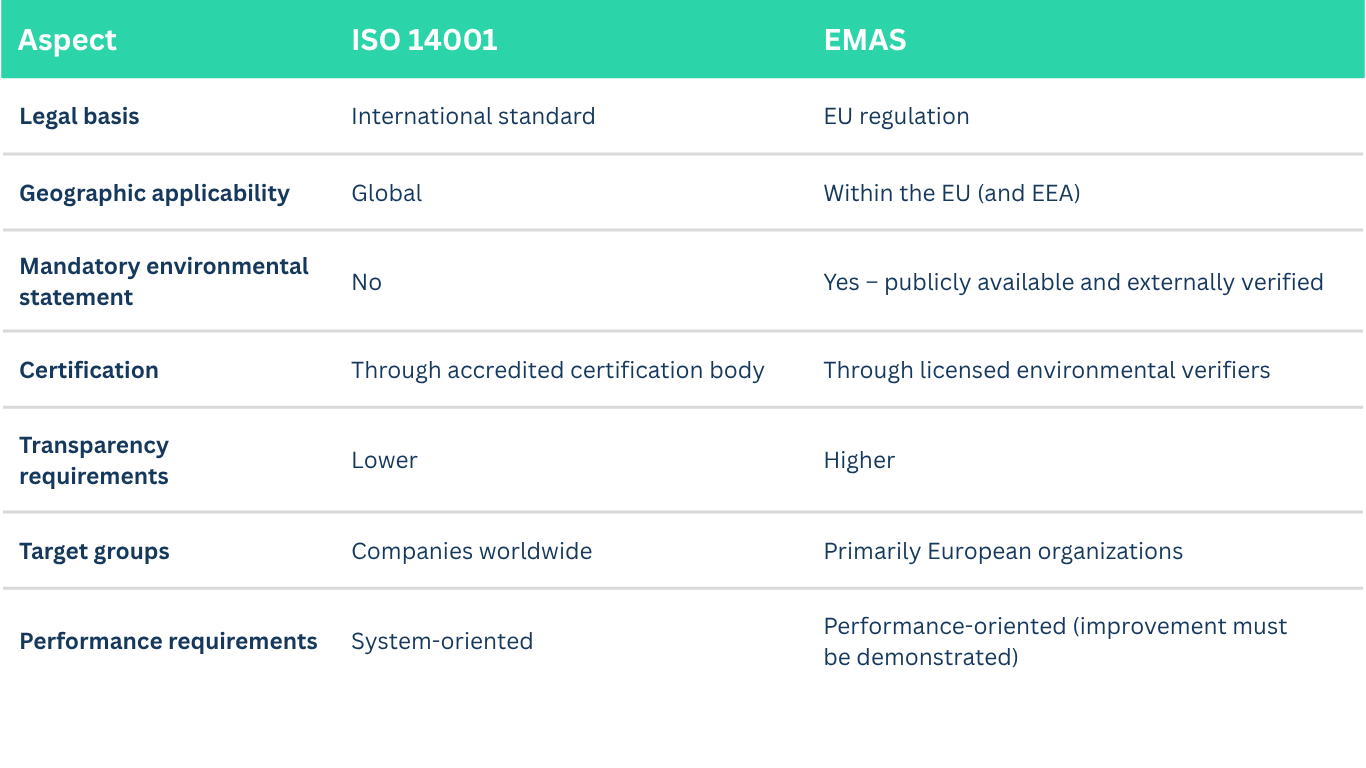
Both systems promote responsible ecological management, but EMAS places significantly higher demands on transparency and evidence of performance.
Which eco management system is right for you?
Depending on strategic goals, market environment, and expectations regarding environmental performance, organizations can choose between ISO 14001, EMAS, or a combination of both. Each path offers advantages, but with different focus areas.
ISO 14001: For internationally active companies and structured environmental management
ISO 14001 is particularly well suited for organizations that want to systematically manage environmental aspects, minimize risks, and ensure legal compliance, without necessarily being required to report publicly.
Typical use cases:
- Companies with international operations or supply chains
- Manufacturing firms subject to environmental regulations
- Organizations integrating sustainability into broader management systems (e.g., ISO 9001, ISO 50001)
- Suppliers required to demonstrate ISO certification by clients
→ Advantage: ISO 14001 is globally recognized and relatively flexible to implement – ideal for organizations aiming to standardize environmental management across international operations.
EMAS: For maximum transparency and publicly documented environmental performance
EMAS goes beyond system structure, requiring measurable performance improvement and a publicly available environmental statement. EMAS is designed for organizations that aim to exceed legal requirements and place a strong emphasis on credibility and external communication.
Typical use cases:
- Companies with a strong sustainability profile and public communication strategy
- Public authorities, cities, and municipalities
- Industries subject to political or societal scrutiny (e.g., energy, chemicals, transport)
- Organizations with environmental reporting obligations or voluntary sustainability disclosures (e.g., under CSRD)
→ Advantage: EMAS enjoys high levels of trust among public authorities, stakeholders, and the general public – largely due to its external validation process.
EMAS + ISO 14001: The combined approach for advanced environmental strategies
Because EMAS fully incorporates all ISO 14001 requirements, organizations can implement both systems simultaneously without redundancy. In practice, EMAS is often seen as “ISO 14001 plus transparency and performance evidence.”
A combined approach makes sense when:
- International sites require ISO certification, but the headquarters aims for public EMAS commitment
- CSR, ESG, or sustainability strategies include measurable environmental performance
- Both formal certification (ISO) and public reporting (EMAS) are needed
- Grant programs or public tenders require EMAS registration
→ Advantage: Organizations benefit from ISO 14001’s global recognition and EMAS’s high credibility, without duplicating processes.
How software can support your ISO 14001 and EMAS implementation
Implementing an environmental management system requires extensive data handling. The need for documentation, evidence tracking, and regular reporting increases with the task's complexity. A specialized ESG software like Envoria can offer targeted support:
- Centralized data collection for environmental indicators (e.g., energy use, emissions, waste)
- Automated data validation and audit routines
- Integrated report editor for EMAS environmental statements
- Interfaces with third-party systems (e.g., energy platforms, ERP systems)
- Audit-ready data history and traceability
- Workflows for review, approval, and documentation of measures and reports
Especially for EMAS, the preparation and ongoing update of the environmental statement are central requirements. Envoria’s KPI Management Module supports both ISO 14001 and EMAS, simplifying the entire data collection and management process by automatically preparing relevant content, tracking versions, and assigning responsibilities based on role and permission settings.
💡 Curious to see how it works? |
|---|