According to recent market analyses, more than 60% of mid-sized companies are already indirectly affected by ESG requirements, particularly through supply chains and financing.
Sustainability is therefore no longer a topic that only concerns large corporations. Mid-sized companies are also under increasing pressure to collect and provide ESG data in a structured way, whether due to regulatory requirements or the expectations of customers, banks, and business partners.
However, mid-sized companies face a particular challenge: ESG data is generated across different areas, from energy consumption and supplier information to HR data, but is often not centrally consolidated. Without a structured solution, it becomes increasingly difficult to meet these requirements efficiently and in an audit-proof way.
What is ESG software for mid-sized companies?
ESG software for mid-sized companies is designed to collect, consolidate, and make sustainability data usable for reporting and internal management in a structured way – without the complexity of traditional enterprise solutions.
At its core, the software handles the following tasks:
- Centralized collection of ESG data from various sources
- Standardization and validation of data
- Support for ESG standards and regulatory requirements
- Creation of reports and analyses
- Provision of data for internal and external stakeholders
The key difference compared to large enterprise platforms lies in the approach:
- Fast to implement
- Clearly structured processes
- Usable without large-scale IT projects
- Flexible and expandable
The goal is not to treat ESG as an isolated topic, but to gradually integrate it into existing business processes.
Typical challenges for mid-sized companies
In practice, many mid-sized companies face similar structural challenges when dealing with ESG data. These challenges often do not result from individual requirements, but from the combination of growing external expectations and internally developed structures. ESG data needs to be consolidated from different areas, updated regularly, and provided for various purposes – often without clear processes or centralized management.
The 5 most common challenges are:
- Limited personnel resources:
ESG is rarely a full-time responsibility in mid-sized companies. Responsibility often lies with individual people or is spread across several departments. - Decentralized data storage and increasing data complexity:
ESG data is generated across different departments, systems, and locations, such as controlling, procurement, or facility management. Without a central structure, there is no unified view, and consolidation quickly becomes confusing and prone to errors. - Manual processes and high effort:
Data collection is often handled through Excel, emails, or individual requests. This takes a lot of time and makes recurring processes more difficult. - Lack of standards and comparability:
Without a clear structure, data is difficult to compare across locations or time periods. Standardized calculation logic is often missing. - Increasing requirements from supply chains or banks:
Customers increasingly request standardized ESG data, for example as part of supplier assessments or ESG questionnaires from banks.
Why Excel and isolated solutions are no longer enough
For many mid-sized companies, Excel is the first step toward ESG reporting. It often works well at the beginning, especially when companies are dealing with individual KPIs or initial analyses. However, as requirements increase, this approach quickly reaches clear limits.
This is mainly because ESG data is generated across the company and only consolidated in Excel afterwards. As a result, structure, consistency, and clear responsibilities are missing.
Typical day-to-day problems include:
- No central data foundation, but multiple versions and files
- Manual maintenance and recurring coordination between departments
- Increasing risk of errors as data volumes grow
- Lack of transparency around data sources and calculations
- No clearly defined workflows or responsibilities
These challenges become more pronounced as requirements increase. It becomes particularly critical when several locations or entities are involved, data needs to be updated and consolidated regularly, or external audits or ESG reports need to be prepared. In these situations, it becomes clear that isolated solutions and Excel are not designed for scalable ESG processes.
The key benefits of ESG software for mid-sized companies
The use of specialized ESG software creates not only efficiency for mid-sized companies, but above all structure and reliability in handling ESG data. This is not only about technology, but also about guidance: many solutions offer pre-structured templates and guidelines that make it easier to get started and help companies implement requirements systematically. Especially with limited resources and increasing demands, this becomes a decisive factor.
10 key benefits at a glance:
- Templates and guidelines for getting started:
Ready-made templates and expert guidance help mid-sized companies understand ESG requirements faster and implement them in a structured way without having to start from scratch. - Structured and centralized data collection:
ESG data is collected and consolidated in one central place instead of being stored in distributed Excel files or isolated solutions. This creates transparency and reduces coordination effort within the company. - High data quality and comparability:
Standardized processes and clear calculation logic reduce errors and enable consistent analyses across time periods and organizational units. - Integration with existing systems:
ESG data can be connected to existing systems such as ERP or finance systems via interfaces. This creates a consistent data foundation without duplicate data maintenance. - Efficient reporting processes:
ESG reports can be created faster, adapted flexibly, and reused for different requirements. This significantly reduces manual effort. - Time savings through automation:
Recurring tasks such as data collection, calculations, or reporting are automated and noticeably relieve operational teams. - Better collaboration within the company:
ESG data can be collected across departments and processed in parallel. Clear roles and workflows improve coordination between everyone involved. - Support for regulatory requirements:
ESG software maps relevant standards such as CSRD, EU Taxonomy, or GRI within the system and makes it significantly easier to implement complex requirements. - Transparency and audit readiness:
Data sources, calculations, and changes remain traceable at all times. This creates security for internal coordination and external audits. - Data-driven decisions:
ESG data is analyzed in a targeted way to identify risks, derive measures, and make well-founded business decisions.
Which ESG functions are truly relevant for mid-sized companies?
Not every function is necessary for every company. For mid-sized companies, the following areas are particularly important:
ESG reporting & standards
- CSRD / ESRS
- VSME as an entry point
- GRI or other voluntary standards
Emissions management
- Scope 1, 2, and 3
- Corporate Carbon Footprint (CCF)
- Reduction measures and climate targets
Supply chain management
- Collecting ESG data from suppliers
- Questionnaires and assessments
- Risk analyses
Data integration
- Interfaces to existing systems
- Import of financial and operational data
Workflows & collaboration
- Task allocation
- Role and permission concepts
- Centralized coordination
Important: ESG software for mid-sized companies should be modular so that it can grow alongside increasing requirements. |
|---|
Especially for mid-sized companies, it makes sense not to rely only on general descriptions when selecting ESG software, but to compare the specific functional scope of the many ESG providers available. Feature lists or module brochures provide helpful guidance and make it easier to quickly understand which ESG areas are covered and how deep the respective functions go.
What mid-sized companies should look for in ESG software
When selecting the right ESG software, mid-sized companies should focus above all on how well the solution can be integrated into existing processes and how easy it is to get started. In addition to functional aspects, it is crucial that the software is actually used in day-to-day work and can grow with future requirements.
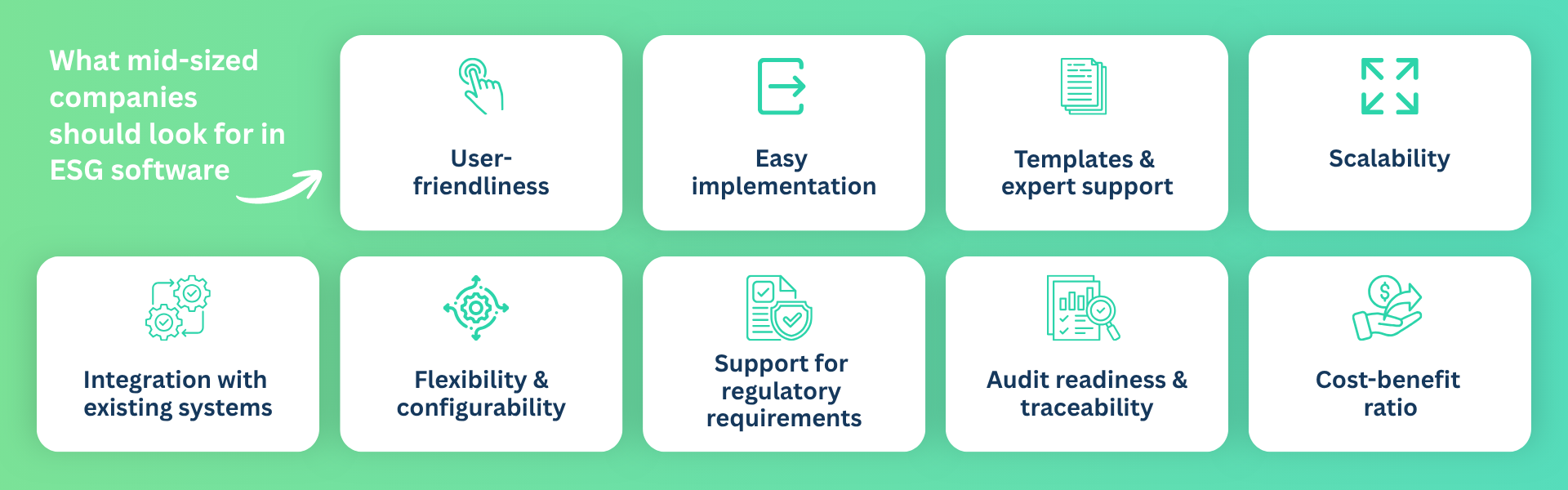
The following criteria provide practical guidance for the selection process:
- User-friendliness:
The software should be intuitive to use and work without extensive training. Especially when several departments are involved, clear user guidance is essential for acceptance. - Easy implementation:
Especially for mid-sized companies, the start should be supported by a guided implementation project to make onboarding easier and faster. Initial ESG data should be captured quickly and expanded step by step. - Templates and expert support:
Ready-made templates and guidelines help companies better understand requirements and set up ESG processes in a structured way. This significantly reduces the initial effort. - Scalability:
The solution should grow with regulatory and internal business requirements, from initial ESG KPIs to comprehensive reporting and additional modules across multiple departments and locations. - Integration with existing systems:
Interfaces to ERP, finance, or other systems help avoid duplicate data entry and ensure a consistent data foundation. - Flexibility and configurability:
Different company structures, locations, or individual requirements should be mapped without major customization effort, preferably using no-code functions. - Support for regulatory requirements:
Standards such as CSRD, EU Taxonomy, or VSME should be supported within the system to make implementation and reporting easier. - Audit readiness and traceability:
All data, calculations, and changes should be transparently documented to support internal and external audits. - Cost-benefit ratio:
The solution should be economically viable for the company and provide clear added value in relation to effort and costs.
ESG software for mid-sized companies: typical use cases
In practice, the need for ESG software in mid-sized companies usually does not arise in abstract terms, but from specific day-to-day business requirements. Companies often face the challenge of collecting and providing ESG data in a structured way and integrating it into existing processes. Typical use cases include:
- Regulatory requirements and reporting:
Companies prepare for requirements such as CSRD, EU Taxonomy, or other regulatory obligations – or start by addressing voluntary standards such as VSME or EMAS. ESG data must be collected, validated, and documented in a structured and audit-proof way. - Supply chain requirements:
Many mid-sized companies are drawn into ESG processes through their customers. This includes standardized ESG questionnaires, supplier assessments, or specific requirements relating to emissions, social standards, and governance structures. - ESG data for financing and evaluation:
Banks, investors, and rating agencies increasingly require reliable ESG KPIs. These feed into credit decisions, financing conditions, and risk assessments, giving them direct economic relevance. - Building a structured sustainability strategy:
Many companies use ESG software to create clear structures for the first time, define climate and sustainability-related business targets, and make progress measurable. The software serves as the foundation for the systematic development of ESG activities.
Conclusion: ESG software is becoming a central management tool for mid-sized companies
ESG software helps mid-sized companies implement growing requirements from regulation, supply chains, and financing in a structured and efficient way. ESG data is collected centrally, processed according to standardized methods, and made usable for reporting and external requests.
At the same time, manual effort is significantly reduced because recurring processes are clearly structured and partly automated. This improves data quality, creates transparency, and makes collaboration between the departments involved easier.
In addition, ESG software makes it possible to connect sustainability data with financial and operational KPIs and use it specifically for corporate management. ESG therefore becomes not only a reporting topic, but an integral part of business decision-making.
The decisive factor is choosing a solution that is easy to implement, creates clear structures, and grows with future requirements.
Tip for selecting ESG software: Companies should first define which requirements are most important, such as CSRD reporting, supply chain requirements, or internal management. It is then worth comparing the functional scope and modules of different providers to quickly see which solution actually covers these requirements and how deep the respective functions go. A solution should not only meet current needs, but also be able to support future requirements. |
|---|