On February 26, 2025, the European Commission presented the so-called “Omnibus Package” with the aim of simplifying the existing sustainability reporting rules and related obligations. This package includes adjustments to the thresholds, content, and timeline of the EU Taxonomy Regulation. Please note: The Omnibus proposal has not yet been finally adopted – following publication by the European Commission, it is now being examined by the relevant parliamentary committees and by the member states in the Council. During this procedure, amendments may still be made, particularly in inter-institutional negotiations (“trilogue”) if different positions exist. |
|---|
The European Sustainability Reporting Standards (ESRS) are the first legally binding European ESG standards and are designed to ensure comprehensive and comparable sustainability reporting. However, the high number of data points, over 1,100, presents companies with enormous challenges – from identifying relevant information to ensuring data quality.
In this guide, you will learn what the ESRS data points are about, what challenges need to be overcome and what steps are necessary to successfully collect the data points, including tips for practical implementation.
| Want to start with the basics? Read everything you need to know about the ESRS in our article: How will the European Sustainability Reporting Standards (ESRS) affect your company? |
|---|
What are ESRS data points?
ESRS data points are specific pieces of information that companies must collect and report in order to meet the requirements of the ESRS. They form the basis for standardized and comparable ESG reporting in accordance with the Corporate Sustainability Reporting Directive (CSRD).
The data points can be divided into three categories:
- Key figures: quantitative values such as carbon emissions or water consumption
- Qualitative information: descriptions of strategies, goals and measures
- Narrative information: context-related explanations, e.g. on the materiality assessment
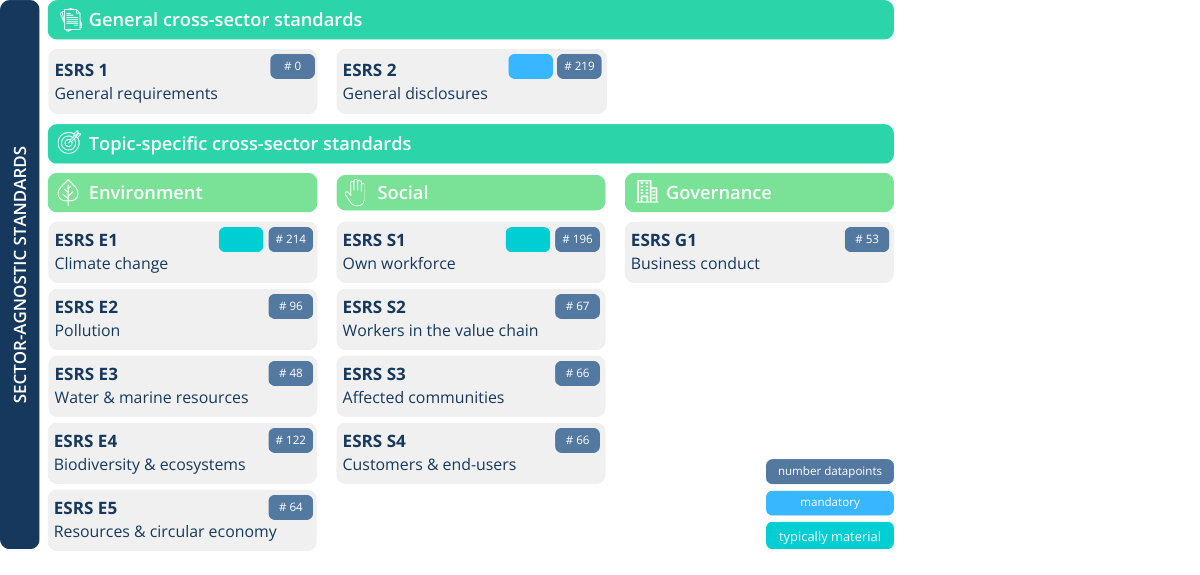
The ESRS are divided into the general standards ESRS 1 and ESRS 2 and the topic-specific standards ESRS E1-5, ESRS S1-4 and ESRS G1. A different number of data points must be disclosed for each of these standards.
The data points according to the individual standards:
- ESRS 2 General disclosures: 219 data points
- E1 Climate change: 214 data points
- E2 Environmental pollution: 96 data points
- E3 Water and marine resources: 48 data points
- E4 Biodiversity and ecosystems: 122 data points
- E5 Resource use and circular economy: 64 data points
- S1 Workforce of the company: 196 data points
- S2 Workforce in the value chain: 67 data points
- S3 Affected communities: 66 data points
- S4 Consumers and end users: 66 data points
- G1 Governance: 53 data points
Challenges in implementation
Data availability
Collecting the necessary data presents companies with significant challenges. Often, data sources are fragmented because relevant information is stored in different departments or even external systems. In addition, ESG data is often not available in the necessary granularity or structure to meet the requirements of the ESRS. Companies can overcome these hurdles by first taking stock of all available data sources. It helps to systematically analyze which data points are already available and where there are still gaps. Working with suppliers and partners can also help to make external data accessible and increase data availability. In addition, it is advisable to form an interdisciplinary team of ESG, finance and IT experts to identify the relevant data points, evaluate their relevance and plan their prioritization in line with the materiality assessment.
Data quality
Ensuring data quality is another key challenge. Standardized processes for consolidating and validating the collected information are often lacking, which can lead to inconsistencies and inaccurate reporting. Robust quality assurance requires the use of control mechanisms, such as plausibility checks and regular audits. In addition, companies should rely on automation to minimize manual sources of error. The introduction of a central data management system can help to ensure that data is consistently recorded and managed. Companies should also define clear responsibilities for data maintenance and quality assurance to ensure that the ESRS requirements are met at all times.
Interface management
ESRS data points affect numerous areas of the company, such as finance, ESG, IT and compliance. A lack of clearly defined responsibilities and inefficient communication structures can significantly delay data delivery. It is therefore essential to integrate a cross-departmental approach.
3 steps to collecting ESRS data points
Step 1: Conduct a materiality assessment
The first step is to identify the relevant topics and the associated data points for your company. To do this, perform a dual materiality analysis. This must include both impact materiality (the company's influence on environmental, social and governance issues) and financial materiality (the influence of sustainability issues on the company's financial performance).
Use the official ESRS AR 16 list to assess IROs (impacts, risks and opportunities) and prioritize them. The results of this analysis often feed into a materiality matrix that provides a clear overview of the key topics.
| Learn more about how to perform the double materiality analysis in our article What is double materiality in the CSRD? |
|---|
Step 2: Identify and map data points
Once the material topics are defined, the corresponding data points from the EFRAG data point list (as of May 2024) can be assigned. The corresponding data points must be reported for all topics identified as material.
The document contains over 1,100 data points, which can seem overwhelming at first glance. However, once you understand the structure and concept of the data point list, it proves to be extremely helpful.
It should be noted that
- not all data points are relevant for every company
- some data points are mandatory regardless of the materiality assessment
- There are phased or conditional data points that need to be considered separately, for example:
- dependent on company size
- industry-specific requirements – e.g. SMEs have extended transition periods or only have to collect a reduced number of data points in order to adapt the additional effort to their capacities
- Staggered requirements – e.g. companies are given time to collect certain complex or novel data points, such as detailed information on Scope 3 emissions or biodiversity impacts.
| 💡Tip 1: Digital tools and software solutions such as Envoria can help to efficiently identify the relevant data points and facilitate their assignment. |
|---|
| 💡 Tip 2: Analyzing industry benchmarks and other organizations' sustainability reports provides valuable insights into commonly used data points and helps identify new challenges early on. Compare your ESRS data points with those of other companies in your industry to ensure that your report meets standards and industry-specific requirements. |
|---|
Step 3: Validate and integrate data
Once the data points to be reported have been identified, it is essential to integrate and validate the information. While integration harmonizes data from different departments and systems and brings it together in a uniform structure, validation ensures that this data is correct, consistent and audit-proof. Through this process, companies can avoid erroneous or duplicate data and ensure that the data is correct, consistent and audit-proof.
Companies should consider the following specific measures:
- Automation: Use of software solutions to continuously collect and process ESG data
- Quality control: Implementation of internal control systems to ensure data quality
- Data consolidation: Development of a central platform that brings together all relevant information and enables standardized reporting
💡 Tip 3: Close collaboration between IT, ESG and finance teams is essential to avoid interface problems and exploit efficiency potential. |
|---|
The future of ESRS data points
Automation potential
The increasing digitalization, for example through the use of machine-readable formats such as XBRL (eXtensible Business Reporting Language), offers great potential for automation. These technologies not only enable companies to create reports more efficiently, but also to improve their comparability and analytical capabilities.
Further development of reporting requirements
As the ESRS reporting standard evolves, sustainability reporting will likely be extended to include more SMEs and non-EU companies operating within the EU – although the specific details of the extended reporting requirement have not yet been finalized. In addition, the European Commission is working on industry-specific standards to meet the specific requirements of various industries.
Integration with global standards
Furthermore, a stronger alignment of the ESRS with frameworks such as GRI and TCFD is expected. This should enable companies to fulfill their reporting requirements with a single report. This would contribute to simplified ESG reporting and greater efficiency for companies.
| 💡 Tip 4: GRI is the most commonly used sustainability reporting standard worldwide. EFRAG and GRI have published a joint interoperability index that shows the relationship between ESRS and GRI data points. This is intended to make it easier for companies that already report according to GRI to transition to ESRS reporting. You can access the document here. |
|---|
Outlook on ESRS data points in CSRD reporting
The ESRS data points are a central building block for the implementation of successful CSRD reporting – but they present companies with complex challenges. Successful implementation requires a double materiality assessment, the identification of relevant data points using the EFRAG lists, and a reliable integration and validation of the information. Digital tools, cross-departmental collaboration and a structured approach help to close data gaps, ensure quality and automate processes. With these measures, companies can not only meet the ESRS requirements, but also benefit in the long term from a well-founded sustainability strategy.
How can Envoria help you?
Envoria's CSRD software makes it easy for you to manage your ESRS data points efficiently. With Envoria, you can automatically capture, calculate and consolidate your relevant ESRS data points across teams – in compliance with CSRD requirements thanks to the integrated ESRS data point list from EFRAG. These and many other features help you make your CSRD reporting efficient and audit-proof.
Find out in a personal meeting how Envoria's CSRD reporting software can support you in your tasks. Book a demo now at: Book demo