In the UK and the Republic of Ireland, FRS 102 is the primary accounting standard for small and medium-sized entities (SMEs) that don’t report under IFRS. On 1 January 2026, the third edition of FRS 102 will take effect, bringing significant changes to lease accounting for lessees and aligning the standard more closely with international practices. Most notably, operating leases that were previously off balance sheet will now need to be recognised. This shift will affect key financial metrics, the presentation of a company’s financial position, and how businesses are evaluated externally.
This article outlines what will change in 2026, which businesses will be affected, and how you can best prepare for the transition.
Lease accounting under FRS 102: current approach and key changes from 2026
Operating vs finance leases in current practice
Under the current version of FRS 102, finance leases are recognised on the balance sheet as both an asset (the leased item) and a liability (the lease obligation). Operating leases, on the other hand, can be accounted for off balance sheet, with lease payments recorded as an expense in the income statement without affecting balance sheet figures. This distinction leads to significant differences in how similar economic obligations are presented, as the classification of a lease as either operating or finance can result in entirely different financial statements for companies with otherwise comparable lease arrangements.
Right-of-Use model to become mandatory under FRS 102 (Third Edition)
From financial year 2026 onwards, lessees will be required to recognise almost all leases on the balance sheet. This means:
- Recognition of a right-of-use asset
- Recognition of a lease liability
Initial measurement will be based on the present value of future lease payments. Short-term leases (up to 12 months) and leases of low-value assets will continue to be exempt from this requirement.
Differences between lease accounting under FRS 102 (Third Edition) and IFRS 16
While FRS 102 (Third Edition) aligns closely with IFRS 16, there are several key differences to be aware of. Under FRS 102 (Third Edition), the following apply:
- Reduced disclosure requirements compared to IFRS 16
- Unchanged lessor accounting model
- Transitional reliefs on initial adoption, including:
- Simplified measurement of the right-of-use asset and lease liability (e.g., use of the discount rate at the transition date)
- Options for a simplified retrospective approach to avoid full restatement of prior leases
- Exemptions for short-term and low-value leases, similar to IFRS 16, but with additional flexibility for judgement
Which companies are affected by the new lease accounting rules under FRS 102?
FRS 102 applies across the UK and Ireland to most small and medium-sized entities (SMEs) that do not report under IFRS and are not eligible for simplified standards such as FRS 105 for micro-entities. The updated lease accounting rules will impact all FRS 102 adopters who act as lessees in lease agreements. The changes will particularly affect sectors where leasing is common, such as retail companies leasing store premises or fixtures, transportation firms operating leased vehicle fleets, and industrial or manufacturing businesses renting machinery or equipment.
Timeline and transitional provisions: When does FRS 102 (Third Edition) take effect?
The UK Financial Reporting Council (FRC) issued the final version of FRS 102 (Third Edition) in March 2024. The new requirements apply to financial years beginning on or after 1 January 2026. Early adoption is permitted on a voluntary basis. Key transitional provisions include:
- Simplified measurement of existing lease arrangements
- No retrospective application to leases that have already ended
- Option to measure the right-of-use asset on a lump-sum basis, based on remaining lease obligations
Impact of the FRS 102 changes on key financial metrics
Starting with the 2026 financial year, lessees will be required to fully recognize their lease agreements under the updated FRS 102 (Third Edition). This change will have a significant impact on key financial metrics and could affect financing arrangements and loan covenants. The standardized recognition of both finance and operating leases on the balance sheet is likely to result in the following:
- EBITDA will increase, as lease expenses are replaced by depreciation and interest charges
- Leverage ratios will rise due to the recognition of new liabilities
- Equity ratios may decline as total assets increase
These shifts will, in turn, influence:
- Loan agreements and compliance with financial covenants
- KPI analysis and corporate financial planning
- Communication with investors and lenders
Transition to FRS 102 (Third Edition): How to prepare effectively
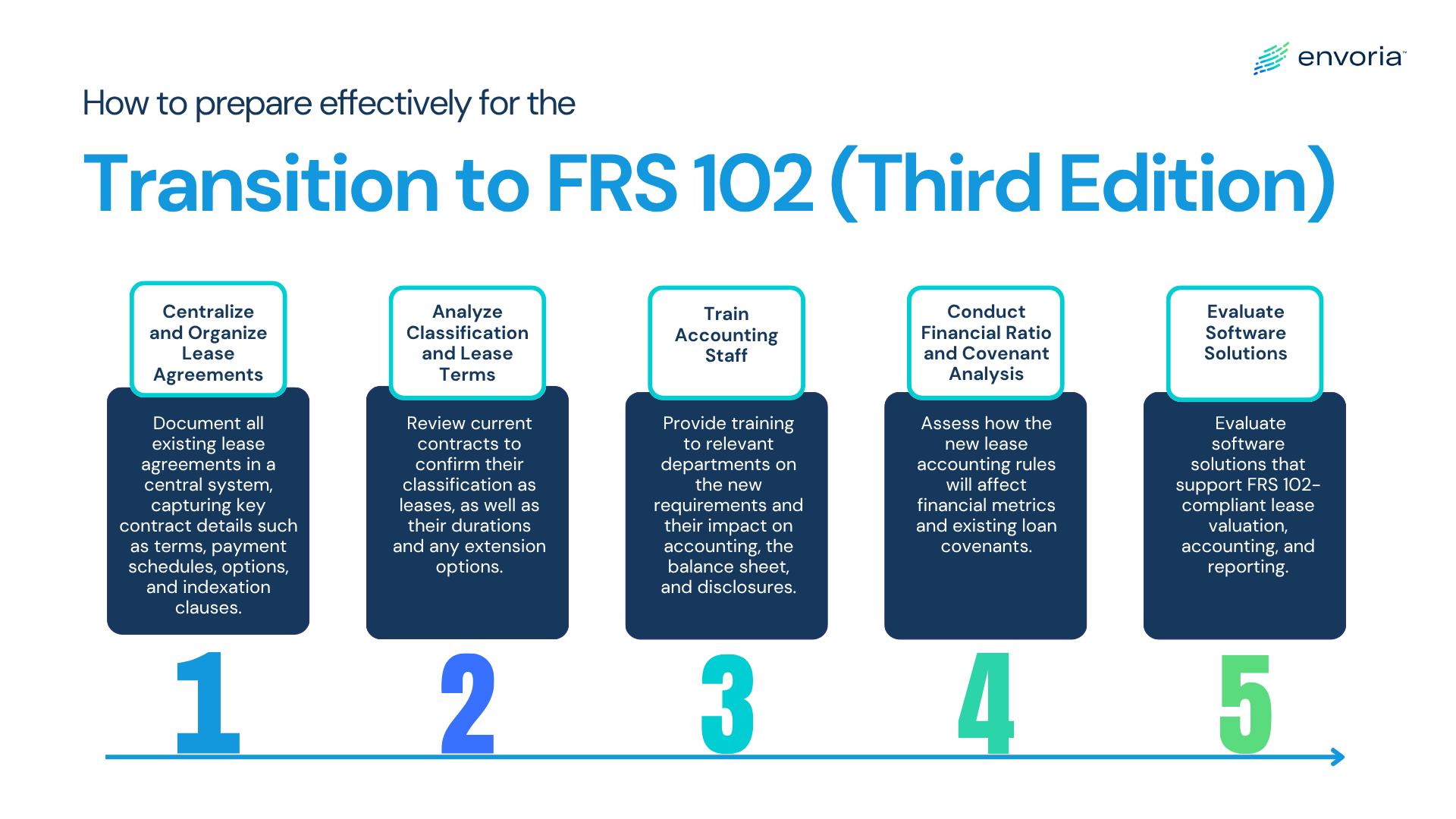
The transition to FRS 102 (Third Edition) requires careful planning, especially for companies with numerous or complex lease arrangements. To ensure smooth communication with banks, investors, and other stakeholders, and to avoid unexpected financial impacts, it is advisable to understand the requirements early and take proactive steps toward a structured transition, such as:
Centralize and organize lease agreements
Document all existing lease agreements in a central system, capturing key contract details such as terms, payment schedules, options, and indexation clauses.
Analyze classification and lease terms
Review current contracts to confirm their classification as leases, as well as their durations and any extension options.
Train accounting staff
Provide training to relevant departments on the new requirements and their impact on accounting, the balance sheet, and disclosures.
Conduct financial ratio and covenant analysis
Assess how the new lease accounting rules will affect financial metrics and existing loan covenants.
Evaluate suitable software solutions
Manual calculations become increasingly inefficient and prone to error as the number of leases grows. Consider software solutions that support FRS 102-compliant lease valuation, accounting, and reporting.
Envoria lease accounting software: Your all-in-one solution for FRS 102
Envoria’s Lease Accounting Software provides a comprehensive solution for managing lease agreements, capturing all relevant contract details and terms. Changes in lease contracts are immediately reflected through automated data processing, ensuring lease liabilities are calculated with the highest accuracy and fully compliant with FRS 102 requirements.
Ready to get started? Learn more about our lease accounting module or book a free demo to see how Envoria can support full FRS 102 compliance! |
|---|