Since the breakthrough of generative artificial intelligence (AI), one question has been discussed across almost every software category: Will companies still need specialized enterprise software in the future? If large language models can analyze documents, process knowledge, answer complex questions, and even develop applications, why should businesses continue investing in dedicated software systems?
This discussion has now also reached the ESG market. At first glance, sustainability reporting and financial reporting appear to be ideal use cases for AI. Large volumes of data, regulatory requirements, documentation, reporting obligations, and complex processes seem to be exactly the type of tasks generative AI was built for. As a result, more companies are asking whether they will still need ESG software in the future – or whether they can build their own AI-powered solutions based on large language models, internal data platforms, or custom ESG copilots.
At first, the question seems reasonable. However, when ESG is viewed not as a theoretical scenario but through the lens of real implementation projects, a much more nuanced picture emerges.
The real question is probably not whether AI can support ESG. The more important question is: Can AI alone take over the tasks that ESG software performs today?
The broader trend: AI is fundamentally changing software
The discussion around ESG is not happening in isolation. Across many areas of software, a fundamental shift is underway. Software is increasingly used not through traditional user interfaces but through natural language.
Instead of navigating menus, fields, and dashboards, users ask questions:
- Which entities have not yet submitted their data?
- Which supplier information is still missing?
- Create a first draft of our sustainability report.
- Which ESRS requirements apply to our company?
The interface is becoming conversational. This is exactly what fuels the assumption that traditional software structures could become obsolete in the long term.
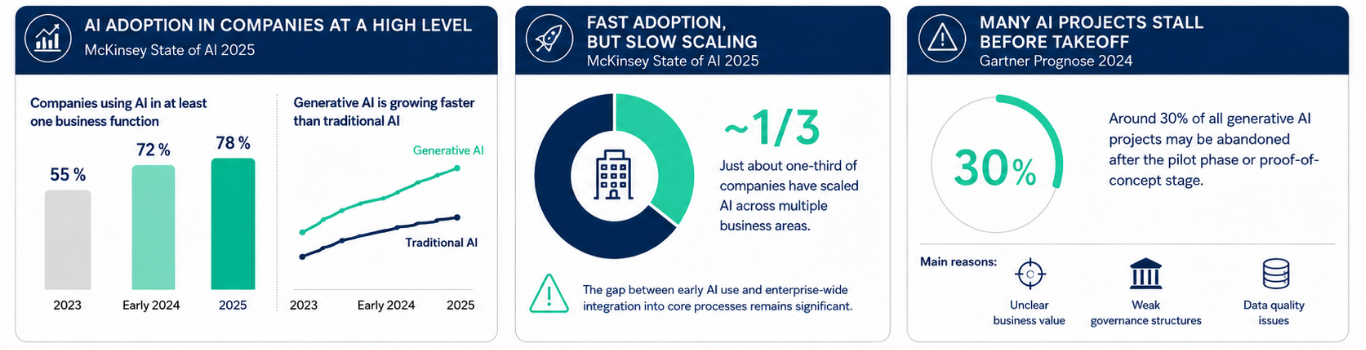
The increasing adoption of AI initially supports this development. According to McKinsey’s 2025 State of AI study, 78 percent of companies now use AI in at least one business function. At the beginning of 2024, the figure was 72 percent, while the previous year it had been only 55 percent. At the same time, the adoption of generative AI is growing significantly faster than the use of traditional AI applications.
Yet another figure is particularly striking: AI adoption is progressing much faster than the sustainable integration of AI into business operations. According to McKinsey, many companies are still in pilot or testing phases. Only around one-third report that AI has actually been scaled across multiple business functions. The gap between initial AI use cases and structural integration into core processes remains substantial.
Analysts are also closely observing this development. Gartner already predicted in 2024 that around 30 percent of all generative AI projects would be discontinued after initial pilot phases or proofs of concept. The reasons? Unclear business value, missing governance structures, and challenges related to data quality.
Trust is where this development becomes particularly interesting. One of the most comprehensive global studies on AI use and trust was conducted in 2025 by the University of Melbourne in collaboration with KPMG. For the study, 48,340 people from 47 countries were surveyed between November 2024 and January 2025.
The results reveal a remarkable tension: 66 percent of respondents now use AI regularly, and 83 percent believe that AI applications offer benefits in principle. At the same time, only 46 percent say they actually trust AI systems. In other words, more than half of the respondents use AI regularly while remaining skeptical of it.
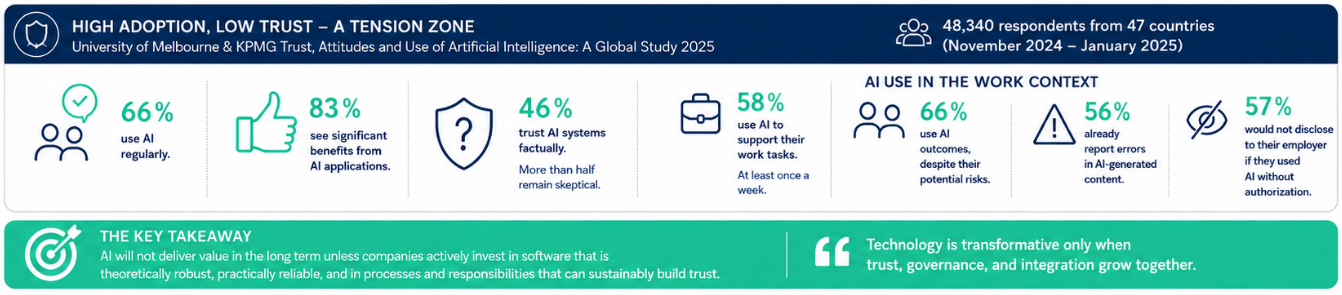
The findings become even more interesting in a workplace context. 58 percent of respondents now consciously use AI for professional tasks; around one-third use it at least once a week. At the same time, 66 percent stated that they use AI-generated results without regularly checking their accuracy. 56 percent reported having already made mistakes in their work due to AI-generated content. Particularly noteworthy: 57 percent said they at least partially conceal their use of AI at work from managers or colleagues.
This development is especially relevant for regulated areas. After all, software is not replaced simply because a technology can theoretically perform a task. It must also be trustworthy enough to take over processes and responsibilities in practice.
Why ESG is not an ordinary AI use case
In many areas of business, AI errors remain manageable. A poorly worded marketing text can be corrected. An inaccurate summary can be adjusted.
In the ESG environment, however, the risks are different.
Anyone interpreting regulatory requirements, consolidating emissions data, or preparing sustainability disclosures is often operating in an environment shaped by reporting obligations, evidence requirements, and potential external audits. Errors here do not merely lead to weaker outputs. They can create reporting risks, undermine data quality, or cause problems during audit processes.
What makes this particularly interesting is that trust in AI appears to vary strongly across contexts. Numerous studies show that users frequently rely on AI for simple productivity or information tasks, but become much more cautious when critical decisions are involved. The greater the potential legal, financial, or technical consequences, the stronger the need for traceable sources, human validation, and institutional accountability.
ESG sits precisely within this area of tension.
Sustainability reporting is not just about gathering information. It involves decisions with regulatory and organizational significance.
This dynamic recurs in practice. In ESG projects, a large part of the work is not about finding answers, but about identifying the right questions in the first place.
- Who is responsible for specific data?
- Which organizational boundaries apply to emissions calculations?
- Which entities need to be included?
- Which methodology is technically defensible?
- What level of data quality is sufficient?
These questions show that in many areas, ESG is less a traditional information problem and more an organizational decision-making process.
There is another important characteristic: ESG questions often lack a single correct answer.
In projects, it regularly becomes clear that companies are not merely searching for information. More often, specialist departments discuss how requirements should be interpreted, which methodology appears suitable, or which approach is technically defensible and sustainable in the long term.
The reality is often not "What is the right answer?", but rather "Which approach can we justify, document, and defend later?".
This is where a central challenge arises for AI systems. Large language models generate answers based on statistical probabilities. ESG, on the other hand, is often based on interpretations, governance structures, and documented decisions. These two logics are not necessarily the same.
Lessons from implementation projects: ESG is more complex than many assume
ESG implementation projects with Envoria regularly show that the complexity of sustainability reporting is often underestimated. Discussions frequently revolve around topics such as which organizational boundaries apply to emissions calculations, how double materiality should be assessed, which data is sufficiently reliable, or how other companies solve comparable questions.
Even experts do not always immediately arrive at the same conclusions.
Workshops and implementation projects often reveal another important observation: Companies are not simply looking for one objectively correct answer. They are looking for guidance. Questions such as “How do other companies handle this?”, “Which approach is typically chosen?” or “What would be understandable later in the audit process?” come up regularly.
This observation is highly relevant. It shows that ESG often resembles an organizational decision-making process more than a mathematical formula. This is hardly surprising, as expertise is not created exclusively from regulatory texts, but also through experience, exchange, and practical interpretation.
In projects, this often leads to situations where even experienced teams discuss several technically defensible approaches. These grey areas are among the biggest challenges in the ESG context.
For AI systems, this creates a fundamental problem: Language models work particularly well when clear patterns and likely answers exist. ESG questions, however, often arise in areas where the most likely answer is not the one that matters most. What matters is the most technically defensible and traceable answer.
Practical implementation, therefore, shows something different: ESG consists to a significant extent of alignment, organizational structure, responsibilities, and decisions.
This observation is also reflected repeatedly in Envoria’s practical work. Even professionals with many years of ESG experience regularly discuss interpretive leeway, methodological approaches, and suitable courses of action. Not because knowledge is missing, but because ESG often consists of justifiable decisions rather than clearly defined truths.
AI can support these processes. Whether it can fully replace them is a different question.
ESG software often solves a different problem than people think
A common assumption is that ESG software is primarily a data repository or knowledge platform. In reality, however, ESG systems often perform much more fundamental tasks.
They create structures for responsibilities, document data origins, manage approval processes, and enable traceable audit trails.
Especially in regulated environments, questions such as the following become increasingly important:
- Who entered the data?
- When were values changed?
- Which source was used?
- Which approvals exist?
- How was a decision documented?
This highlights a key difference between AI and enterprise software. An AI system can provide an answer. An audit trail, however, must remain permanently traceable.
Build vs. buy: Can companies replace ESG software themselves in the future?
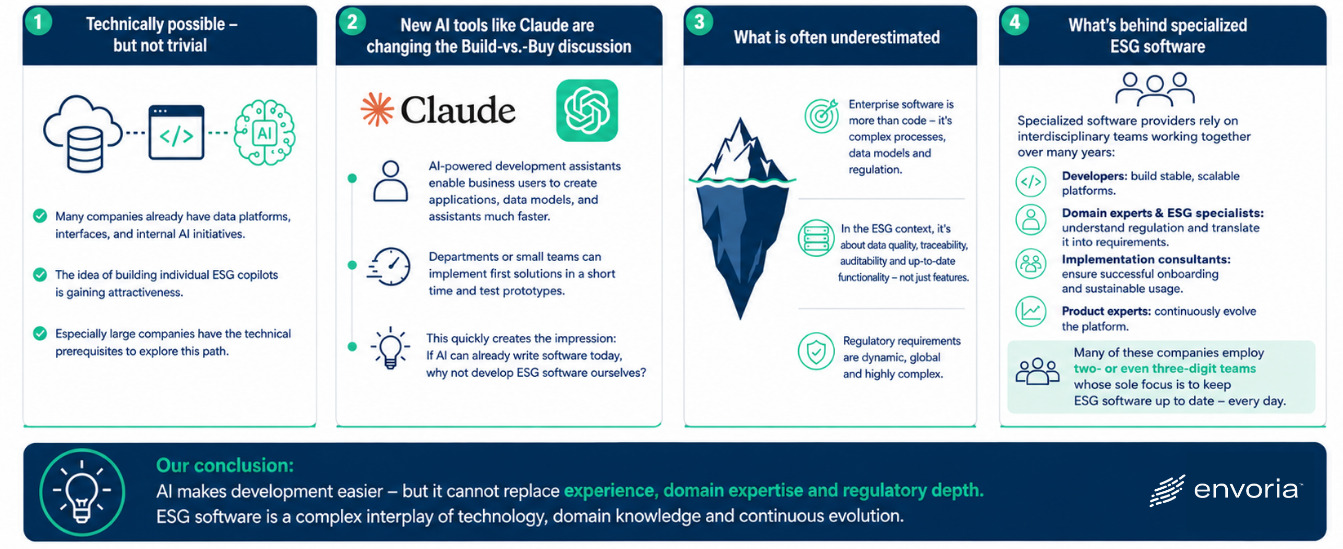
From a technical perspective, this initially seems possible. Many companies already have data platforms, interfaces, and their own AI initiatives. This increasingly gives rise to the idea of building custom ESG copilots. Large companies in particular may pursue this path.
New AI tools like Claude are changing the build vs. buy discussion
New AI tools, such as Claude and GPT-based development assistants, are adding further momentum to this discussion. Just a few years ago, developing custom applications usually required extensive development resources. Today, scenarios are emerging in which specialist departments or small teams can use AI to create first applications, data models, or internal assistants in a comparatively short time. This can quickly create the impression that if AI can already code software today, why should companies not simply build ESG software themselves?
This is precisely why the assumption often arises that specialized software could become easier to replace in the future.
However, this often underestimates what actually sits behind enterprise software. In the ESG space in particular, specialized software providers often have teams of developers, subject-matter specialists, ESG experts, implementation consultants, and product experts working together on platforms for years. Some companies employ teams ranging from dozens to hundreds of people whose sole responsibility is to monitor regulatory developments, assess requirements from a technical perspective, continuously develop the software, and keep processes up to date over the long term.
The real challenge begins after development
Practice shows that the biggest challenge often does not lie in the performance of language models themselves. Implementation projects suggest something else: The real complexity often begins only when a technical possibility is supposed to become a reliable business process. The challenge usually does not lie in the reporting itself, but in building the structures behind it. In practice, the question is rarely just “How do we create a sustainability report?”. More often, it is about creating processes that work reliably over time, ensure data quality, and remain robust in future reporting years.
This is where additional requirements come into focus. Suddenly, questions such as these become central: Which data source is the leading source? How are regulatory changes kept up to date? How can AI-generated content be reviewed? Who takes responsibility for decisions? How are hallucinations identified? And how is traceability created?
In several studies, McKinsey points out that companies currently struggle less with the technology itself and more with integrating it into existing organizational structures. The real challenges often lie in governance, data structures, and scaling.
In the ESG context, this raises a decisive question: Is a proprietary AI solution truly simpler than an established ESG platform, or does it merely shift the complexity elsewhere?
Trust is not created by answers alone, but by accountability
An interesting parallel can be seen in information behavior itself. AI is increasingly being used as a search and knowledge tool. At the same time, practice shows that when dealing with critical topics, users often continue to rely on established sources, experts, or institutions.
The reason often lies less in the quality of individual answers and more in the question of accountability. Established media outlets, audit firms, and specialist institutions have editorial teams, experts, review mechanisms, and traceable processes behind them.
AI systems, by contrast, often provide answers with a high degree of linguistic confidence, while their uncertainties, weightings or decision paths are not always transparent.
For regulatory topics in particular, this creates a central challenge. ESG reporting requires not only results but also traceability.
AI may replace interfaces, not systems
The discussion about ESG and AI is often framed as an either-or question: AI or ESG software.
But this comparison may be too simplistic.
A more likely scenario is this: AI will fundamentally change how ESG software is used, without fully replacing the underlying systems. In the future, users may no longer manually navigate through reporting structures but instead ask questions. AI could prepare data, provide guidance, summarize content, or identify anomalies. Under the surface, however, the same requirements remain: data models, governance structures, authorization concepts, approvals, integrations, and auditability.
Gartner predicts that by 2028, around 33 percent of all enterprise applications will integrate agentic AI capabilities. At the same time, around 15 percent of everyday business decisions are expected to be made at least partially autonomously. However, this forecast does not describe a world without software. It describes software that is changing.
Instead of operating rigid interfaces, users could interact with intelligent systems that access existing processes, data models, and enterprise structures. The underlying infrastructure does not disappear. It simply becomes less visible. This is precisely why the long-term question may be less about replacing ESG software and more about what form ESG software will take in the future.
In other words, AI could change user interfaces. Not necessarily the underlying systems.
From today’s perspective, the greatest potential of AI therefore seems to lie less in replacing ESG software and more in intelligently enhancing it. Experience from ESG projects shows that sustainability reporting is rarely a matter of missing information. More often, it is about structure, collaboration, responsibilities, and trust.
Sources
- KPMG & University of Melbourne (2025): Trust, Attitudes and Use of Artificial Intelligence: A Global Study 2025 (Befragung von 48.340 Personen in 47 Ländern)
- McKinsey & Company (2025): The State of AI: How Organizations Are Rewiring to Capture Value
- Gartner (2024): Predicts 2025: Generative AI Projects and Enterprise Adoption Trends
- Business Insider (2025): Analyse und Einordnung der KPMG-Studie zur KI-Nutzung im Arbeitsumfeld
- Forschungsarbeiten zu Vertrauen, KI-Nutzung und Entscheidungsverhalten in risikobehafteten Kontexten (2024–2025)
- Harvard Business Review (2024): How People Decide Whether to Trust AI