Extreme weather events, rising temperatures, flooding and water scarcity are already a reality. For companies, they pose direct economic challenges today and will become even more significant in the future. Companies' own sites may be exposed to climate hazards, as may key suppliers or transport routes.
As a result, robust climate risk assessments are becoming increasingly important for companies – not only in a regulatory context but also for investment decisions and corporate risk management.
But does a comprehensive climate risk analysis necessarily have to cost money? Numerous public institutions, research organisations and other organisations provide climate data and analytical tools free of charge. In addition, a wide range of commercial providers support companies in identifying, assessing and documenting their climate risks.
What are the differences? What can free climate risk assessment tools offer, where are their limitations, and when is a paid solution worth the investment?
Let's take a closer look!
Can you conduct a climate risk assessment for free?
The good news first: in principle, yes. Companies can access a wide range of freely available climate data, climate models and analytical tools to assess their physical climate risks. Public institutions and scientific organisations, in particular, provide high-quality data.
However, it is important to distinguish between free climate data and comprehensive climate risk analyses. While free tools provide information on specific climate hazards, geographical regions or climate scenarios, companies often have to consolidate and interpret this information themselves and apply it to their individual sites and economic activities.
Access to free climate data therefore does not automatically translate into a free or comprehensive climate risk assessment.
What free climate risk analysis tools are available?
Depending on their objectives, companies can choose from a variety of free tools and data sources. Some provide a general overview of natural hazards, while others focus on specific climate hazards or provide scientific climate data for further processing.
The following overview presents a selection of international and regional tools and resources provided by public institutions, research organisations and non-profit organisations:
Tool / Data source | Provider | Geographical coverage | Primary focus |
ThinkHazard! | GFDRR / World Bank | Worldwide | Initial assessment of various natural hazards |
DWD Climate Atlas | German Meteorological Service (DWD) | Germany | Historical and future climate trends |
WWF Water Risk Filter | WWF | Worldwide | Water-related risks |
Copernicus Climate Data Store | European Copernicus Programme | Worldwide, partly regional | Climate data and climate projections |
IPCC Interactive Atlas | Intergovernmental Panel on Climate Change (IPCC) | Worldwide | Global and regional climate projections |
CLIMADA | ETH Zurich | Worldwide | Scientific modelling of climate risks and damages |
Aqueduct Water Risk Atlas | World Resources Institute (WRI) | Worldwide | Water stress, droughts and flooding |
Climate Impact Explorer | Climate Analytics | Worldwide | Future climate impacts and different climate scenarios |
Coastal Risk Screening Tool | Climate Central | Coastal regions worldwide | Sea level rise and coastal flooding |
Climate Change Knowledge Portal | World Bank | Worldwide | Historical climate data, future projections and country-specific risk profiles |
This list represents a non-exhaustive international selection of tools and resources offering freely accessible features or data on climate hazards. Functionality, geographical data availability and terms of use may vary depending on the provider. Any applicable licensing conditions must be taken into account when using these resources for commercial purposes.
This selection illustrates how widely the focus of free tools can vary. While some tools provide a simple and accessible introduction to climate risk assessment, others require employees to have advanced knowledge of climate science, data analysis or geoinformatics.
Why a single free climate risk assessment tool is often not enough
Different data sources and limited coverage
One of the biggest challenges when using free climate risk tools is their sometimes limited scope. While some tools provide detailed information on specific climate hazards such as water stress, droughts or coastal flooding, others focus on general climate trends and future projections.
Geographical coverage also plays an important role when selecting suitable tools. While national resources may provide more detailed information on individual countries and regions, international data sources offer a cross-country basis for analysis. For companies with sites in multiple countries, in particular, this can mean additional work, as they often need to combine different regional and global resources.
Free climate risk analysis tools also differ in terms of the following criteria:
- Number and types of climate hazards covered
- Spatial resolution of climate data
- Available climate scenarios and time horizons
- Underlying assessment methodologies and risk classifications
- Export and documentation options
A comprehensive climate risk assessment may therefore require a combination of several tools and data sources.
The quality of free data is by no means inherently lower than that of commercial solutions. Professional providers also make use of publicly available scientific data in some cases. However, companies using free resources often have to process, evaluate and combine the data themselves to produce a consistent and comparable climate risk analysis.
Practical example: Climate risk assessment of a manufacturing site
A manufacturing company wants to assess which physical climate risks one of its sites could be exposed to by 2050.
To do so, it uses, for example:
- the WWF Water Risk Filter to assess water-related risks,
- the DWD Climate Atlas to assess future temperature and precipitation trends,
- local flood and heavy rainfall hazard maps,
- and international climate databases for further climate projections.
Each of these sources provides valuable information. However, this does not automatically result in a consistent risk profile for the manufacturing site.
The company must consolidate the results, account for different assessment methodologies, identify potential data gaps and evaluate the significance of individual climate hazards for its buildings, facilities and production processes.
For multiple sites, particularly across different countries, this workload can increase considerably. Not every data source is equally suitable or available for all sites.
From climate hazards to actual business risks
Another important distinction is the difference between identifying a climate hazard and assessing the resulting risk.
For example, an elevated flood hazard at a particular site does not necessarily mean that significant economic damage is to be expected.
Relevant factors may include how vulnerable a company's buildings and facilities are, which protective measures are already in place and what the consequences of a potential business interruption would be.
A robust climate risk assessment therefore takes three key components into account:
- Climate hazard (Hazard): What climate-related events or changes could occur?
- Exposure: Which sites, assets or activities are exposed to these hazards?
- Vulnerability: How susceptible are the affected sites, assets or activities?
Many freely available data sources focus primarily on climate hazards or exposure. A company-specific vulnerability assessment often needs to be conducted separately.
Even when using commercial solutions, it remains important to consider individual site and company information. Automated risk assessments can support this process but do not always replace expert review.
Free vs. paid climate risk analysis: A direct comparison
Ultimately, the most suitable solution for a company depends on its individual requirements, available resources, time constraints and desired level of detail.
The following table highlights typical differences between free climate risk assessment tools and professional, paid solutions.
Comparison criterion | Free tools | Paid solutions |
Acquisition costs | No or low direct costs | Assessment fees or licensing costs |
Scientific data foundation | In some cases, very high quality | Often based on scientific and supplementary data sources |
Climate hazard coverage | May focus on specific hazards, depending on the tool | Often combines multiple climate hazards in a single solution |
Geographical coverage | Regional or global, depending on the tool | Often covers multiple countries |
Climate scenarios and time horizons | Vary depending on the data source | Often selectable within a single platform |
Data consolidation | Often requires manual work | Often already integrated |
Comparability of results | Assessment methodologies may differ | Often based on a consistent methodology |
Analysis of multiple sites | May involve manual work, depending on the tool | Often automated and scalable |
Company-specific assessment | Often needs to be conducted independently | Integrated assessment features, depending on the provider |
Documentation | Often needs to be prepared independently | Often includes standardised reports |
Regulatory requirements | Independent methodological review required | May include features designed to address regulatory requirements |
Support | Varies | Expert or technical support, depending on the provider |
The actual services provided vary across both free and paid offerings. The decisive factor is therefore not the price alone, but also the scope of the respective solution.
The hidden costs of a free climate risk assessment
Internal time and resource requirements
Free climate risk tools can be particularly attractive to companies with limited budgets or those looking to gain an initial understanding of their climate risks. However, when selecting a suitable climate risk solution, companies should consider more than just the immediate acquisition costs.
Even when access to climate data is free of charge, internal costs may arise. The more tools, sites and climate scenarios that need to be considered, the greater the internal workload may become.
Internal costs may include the following tasks:
- Researching and selecting suitable data sources
- Familiarising employees with different analytical tools
- Interpreting scientific climate data
- Consolidating different results
- Harmonising assessment methodologies
- Identifying and closing data gaps
- Preparing reports and supporting documentation
- Ensuring the quality of results
- Updating existing climate risk analyses
Another consideration is whether the necessary expertise is available within the company or whether additional external support may be required.
Cost example: How much does a free climate risk analysis actually cost?
A company wants to assess the physical climate risks of 20 sites. It uses exclusively freely available data sources and analytical tools for this purpose.
Cost factor | Illustrative assumption |
Licensing costs for free tools | EUR 0 |
Number of sites | 20 |
Internal analysis time per site | 3 hours |
Total site-specific analysis time | 60 hours |
Internal hourly rate | EUR 80 |
Subtotal: Site-specific personnel costs | EUR 4,800 |
Research, familiarisation and development of a consistent assessment methodology | Additional effort |
Overall documentation and quality assurance | Additional effort |
Total cost of the climate risk assessment | EUR 4,800 plus additional costs |
In this hypothetical example, the site-specific analysis alone generates internal personnel costs of EUR 4,800. This does not include overarching tasks or potential follow-up costs associated with regularly updating the assessment.
Assessing 20 sites is still a relatively manageable undertaking. International companies, real estate companies or businesses with extensive site and asset portfolios may need to assess the climate risks of several hundred or even thousands of sites.
Assuming a constant analysis time per site, site-specific personnel costs alone would amount to EUR 24,000 for 100 sites and EUR 240,000 for 1,000 sites – excluding the additional costs mentioned above.
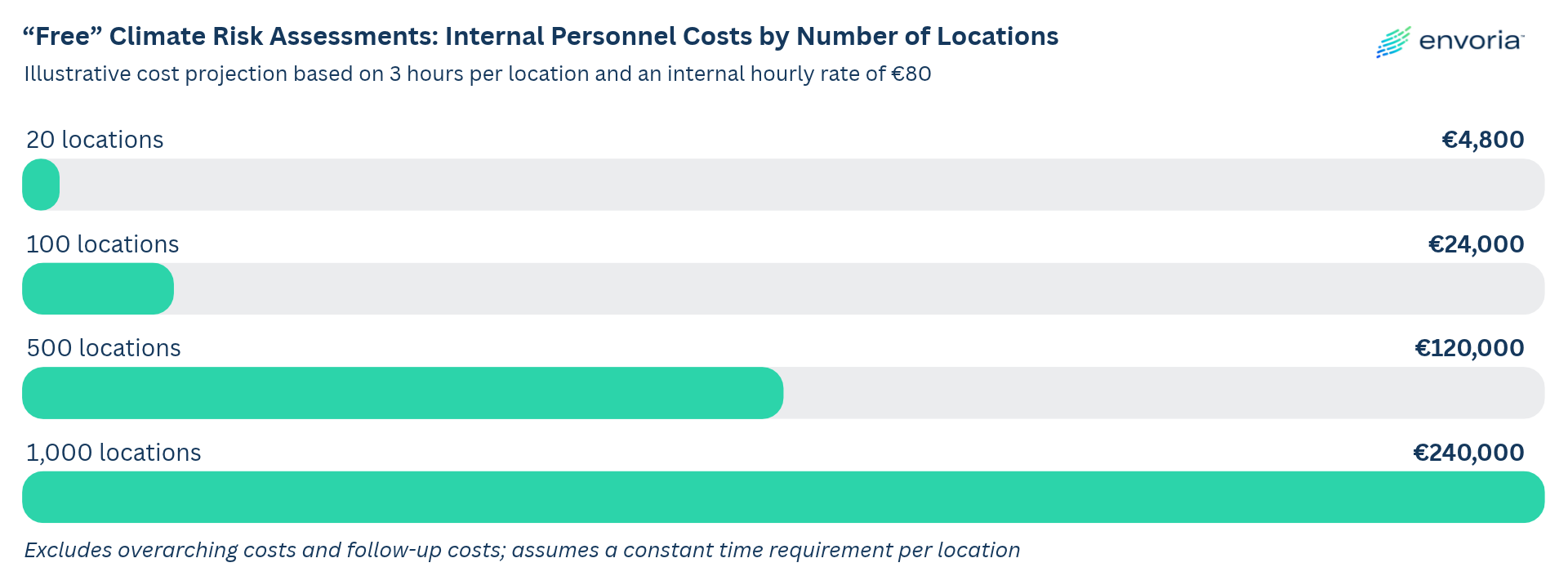
Illustrative extrapolation based on a constant analysis time of 3 hours per site and an internal hourly rate of EUR 80. Overarching tasks and follow-up costs are not included. In practice, economies of scale and internal automation may reduce costs.
Particularly for larger site portfolios, the scalability of the chosen solution therefore becomes increasingly important. Paid solutions also involve internal effort, of course. However, pre-processed data and automated workflows can often help reduce this workload.
To make a cost-effective decision, companies should therefore compare the actual total costs of both approaches rather than focusing exclusively on licensing or assessment fees.
Are free climate risk assessments sufficient for the EU Taxonomy and CSRD?
Many companies wonder whether free tools are suitable for meeting regulatory requirements such as the EU Taxonomy or sustainability reporting under the CSRD and ESRS. There is no universal answer to this question.
In principle, using paid software is not a prerequisite for conducting a climate risk analysis that meets regulatory requirements. What matters is whether the methodology, climate hazards, climate scenarios, assessment and documentation comply with the applicable requirements.
A robust climate risk and vulnerability assessment under the EU Taxonomy involves, among other things, the following aspects:
- Systematic identification of relevant physical climate hazards
- Consideration of appropriate climate projections and time horizons
- Assessment of impacts on the respective economic activities
- Vulnerability assessment
- Identification of necessary adaptation solutions
- Clear and traceable documentation of results
In principle, companies can also meet these requirements using free data sources. However, they must independently ensure that their chosen approach fully addresses all relevant requirements.
Assessing physical climate risks may also be relevant for sustainability reporting under ESRS E1. However, the specific requirements differ from those of the EU Taxonomy and depend on the applicable reporting obligations and materiality assessment.
A professional solution can simplify these processes by providing suitable data, assessment features and documentation options in one place. However, using such a solution alone does not guarantee regulatory compliance.
When are free climate risk analysis tools a good choice?
Free tools can be a suitable solution, particularly when companies:
- are addressing their climate risks for the first time,
- need an initial assessment of individual sites,
- want to investigate a specific climate hazard,
- already have in-house expertise in climate science or assessment methodologies,
- want to supplement existing climate risk assessments with additional data,
- or have sufficient personnel resources to independently evaluate and document the results.
Free tools can also make a valuable contribution as supplementary sources of information within an existing climate risk management framework. For companies seeking an initial overview or addressing a clearly defined question, a free solution can therefore be a sensible choice.
When is a paid climate risk assessment worth the investment?
A professional climate risk analysis can be particularly beneficial when the scope or complexity of the assessment increases.
This may be the case, for example, when:
- numerous climate risks need to be considered,
- multiple national or international sites need to be analysed,
- different climate scenarios and time horizons are relevant,
- comparable risk assessments are required across all sites,
- results need to be documented for investment decisions or regulatory purposes,
- internal resources or climate science expertise are limited,
- or climate risk assessments need to be updated regularly.
A paid climate risk assessment does not necessarily require purchasing a long-term software licence. Depending on the company's needs and the available offerings, individually commissioned climate risk analyses can also be a cost-effective alternative to a full software licence or independent research and evaluation. This approach can be particularly attractive to companies that need a site-specific assessment at short notice or do not initially want to implement additional software.
Tip: Climate risk assessments with Envoria – with or without software
The Envoria platform offers companies two ways to systematically assess their physical climate risks: individually orderable climate risk assessments or an integrated software solution.
Individual climate risk assessments without a software licence
Companies that require a site-specific climate risk analysis but do not want to introduce additional software can order individual assessments directly from Envoria. Both individual sites and extensive site portfolios requiring more than 10,000 assessments can be analysed.
The results are provided for each site in a comprehensive PDF report of approximately 45 pages. This includes site-specific risk assessments, information on the selected climate scenarios and assessment periods, as well as references to data sources.
Instead of independently researching, evaluating and combining various free tools, companies receive the results in a single, structured report.
Climate risk analysis with Envoria software
For companies looking to integrate climate risks into their business processes on an ongoing basis, Envoria also offers a centralised software solution.
Among other features, the software supports companies with:
- Automated initial assessments for 28 different hazard types
- Worldwide site-specific climate risk analyses
- Individually selectable climate scenarios and time horizons up to 2100
- Visualisation and comparison of climate risks
- Company-specific risk assessments
- Definition and documentation of adaptation measures
- Integration of results into existing ESG and EU Taxonomy processes
This enables companies to reduce the effort involved in independently researching, processing and consolidating different data sources and focus more on assessing and managing their actual climate risks.
→ Learn more about Envoria's climate risk assessments
Conclusion: The right climate risk assessment is not necessarily the cheapest
Free climate risk tools provide valuable access to scientific data and can offer a suitable foundation for assessing physical climate risks.
Particularly when addressing more complex questions, however, the challenge lies in combining different data sources, considering all relevant climate hazards and translating the results into a consistent, company-specific risk assessment.
Whether a free or paid solution is more suitable therefore depends on more than just the available budget. The desired scope of the analysis, the number of sites, regulatory requirements and available internal resources are equally important.
A professional climate risk analysis, such as those offered by Envoria, can be worthwhile even for a single site if it eliminates extensive research and evaluation work. For larger site portfolios, the automation, comparability and scalability of the assessment become increasingly important.
Ultimately, the goal is not to collect as much climate data as possible, but to establish a reliable foundation for business decisions.