Many companies struggle with ESG questionnaires not because of missing information, but because they rely on manual processes. ESG-related questions are answered across emails, spreadsheets, shared drives, and PDFs, often under time pressure and without a clear overview of responsibilities, progres,s or evidence.
A structured, software-supported workflow helps replace these fragmented approaches with a repeatable process. The following example shows how software tools like Response AI can support each step of an ESG questionnaire workflow in practice.
💡Tip: Use the free version of Envoria's Response AI software tool to quickly answer ESG questionnaires. |
|---|
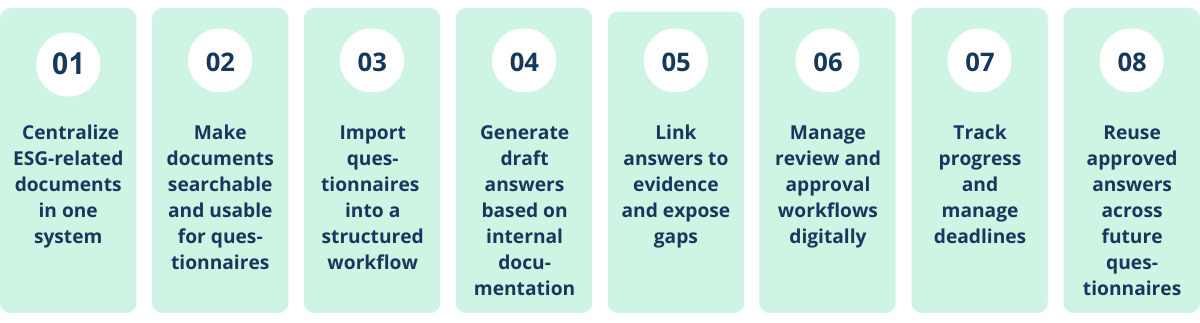
8 steps to answer ESG questionnaires with a structured software workflow
Step 1: Centralize ESG-related documents in one system
Without software, ESG documents are typically spread across shared drives, email attachments, and personal folders. Teams waste time searching for policies, reports, or spreadsheets and risk using outdated versions.
A dedicated software solution provides a central document library for storing, versioning, and accessing ESG-related documents by all relevant teams. This creates a single source of truth and ensures that all questionnaire answers are based on the same, up-to-date documentation.
Step 2: Make documents searchable and usable for questionnaires
Simply storing documents centrally does not solve the problem. Without structure, teams still need to manually search through long PDFs, Word, or Excel files.
Software can index documents and make their content searchable at a granular level. This allows teams to quickly identify relevant sections, understand which documents support which ESG topics, and link answers directly to specific sources. What previously required manual searching becomes a structured, repeatable process.
Step 3: Import questionnaires into a structured workflow
Answering ESG questionnaires directly in spreadsheets or PDFs makes it difficult to track progress or reuse content. Each new questionnaire starts from scratch.
With software, questionnaires can be imported into a structured interface where each question is captured individually. Question types are identified, questions can be edited and grouped, and responsibilities can be assigned. This creates consistency across ESG questionnaires, RFIs, and RFPs and lays the foundation for reuse.
Step 4: Generate draft answers based on internal documentation
Manually drafting answers is time-consuming and often leads to inconsistencies. Different teams phrase similar answers differently or rely on assumptions rather than documented facts.
Digital, AI-supported tools such as Envoria's Response AI can support this step by generating draft answers based on the company’s own documents. These drafts reflect existing policies and reports instead of external sources. Importantly, drafts are clearly marked as such and require review before approval, keeping humans in control of the final content.
Step 5: Link answers to evidence and expose gaps
One of the biggest challenges in ESG questionnaires is evidence. Without software, teams often struggle to show where an answer comes from or whether supporting documents exist.
A questionnaire software can link each answer directly to its underlying documents, including references to specific sections or pages. Where no suitable evidence is available, gaps become visible immediately. This allows teams to address missing documentation proactively rather than submit unsupported answers.
Step 6: Manage review and approval workflows digitally
Review and approval are often handled informally via email or in document comments. This creates uncertainty around responsibilities and approval status.
A software-supported workflow introduces clear statuses such as draft, in review, and approved. Reviewers can validate content, check evidence, and approve answers directly in the system. This is particularly important when finance, risk, or compliance teams are involved and accountability matters.
Step 7: Track progress and manage deadlines
Without software, tracking the status of an ESG questionnaire often requires manual checklists or status meetings. Teams lack a real-time overview of progress.
Software provides progress tracking at both the question and questionnaire levels. Teams can see which questions are completed, under review, or still open. This visibility supports deadline management and reduces last-minute escalation.
Step 8: Reuse approved answers across future questionnaires
Approved ESG answers often disappear into archived files and are recreated for the next request.
With a questionnaire tool, approved answers are stored and reusable. Over time, this creates a growing, document-based knowledge base that can be applied to future ESG questionnaires, RFIs, and RFPs. Reuse improves consistency, reduces effort, and lowers dependency on individual contributors.
How software changes ESG questionnaire workflows
The eight-step workflow outlined above illustrates how ESG questionnaires can be handled in a structured and repeatable way, from centralizing documents to reusing approved answers over time. In practice, however, managing this process manually becomes increasingly difficult as the volume and complexity of ESG requests grow.
Software-supported workflows address this challenge by connecting documents, questions, answers, evidence, and approvals in one structured environment. Solutions such as Envoria's Reponse AI are designed to support exactly this kind of end-to-end process, providing transparency, traceability, and clear responsibilities across all steps of the workflow – without replacing human review or expertise.
Rather than reacting to each ESG questionnaire individually, companies can establish a consistent process that turns recurring requests into a manageable routine. This shift improves collaboration across teams, strengthens evidence-based communication, and builds confidence with customers, investors, and other stakeholders.