The EU Packaging and Packaging Waste Regulation (PPWR) has applied since August 12, 2026, introducing new requirements for packaging and packaging compliance. These requirements are being phased in over time. Some already apply, such as the general requirement that packaging must be recyclable, while others, including detailed requirements relating to recyclability, recycled content, and labeling, will take effect in the coming years.
Companies must comply with current obligations while preparing for future requirements. This means keeping track of which rules apply to their packaging and when, collecting the necessary data, and assessing compliance. Where necessary, companies must also modify their packaging, maintain supporting documentation, and prepare declarations of conformity.
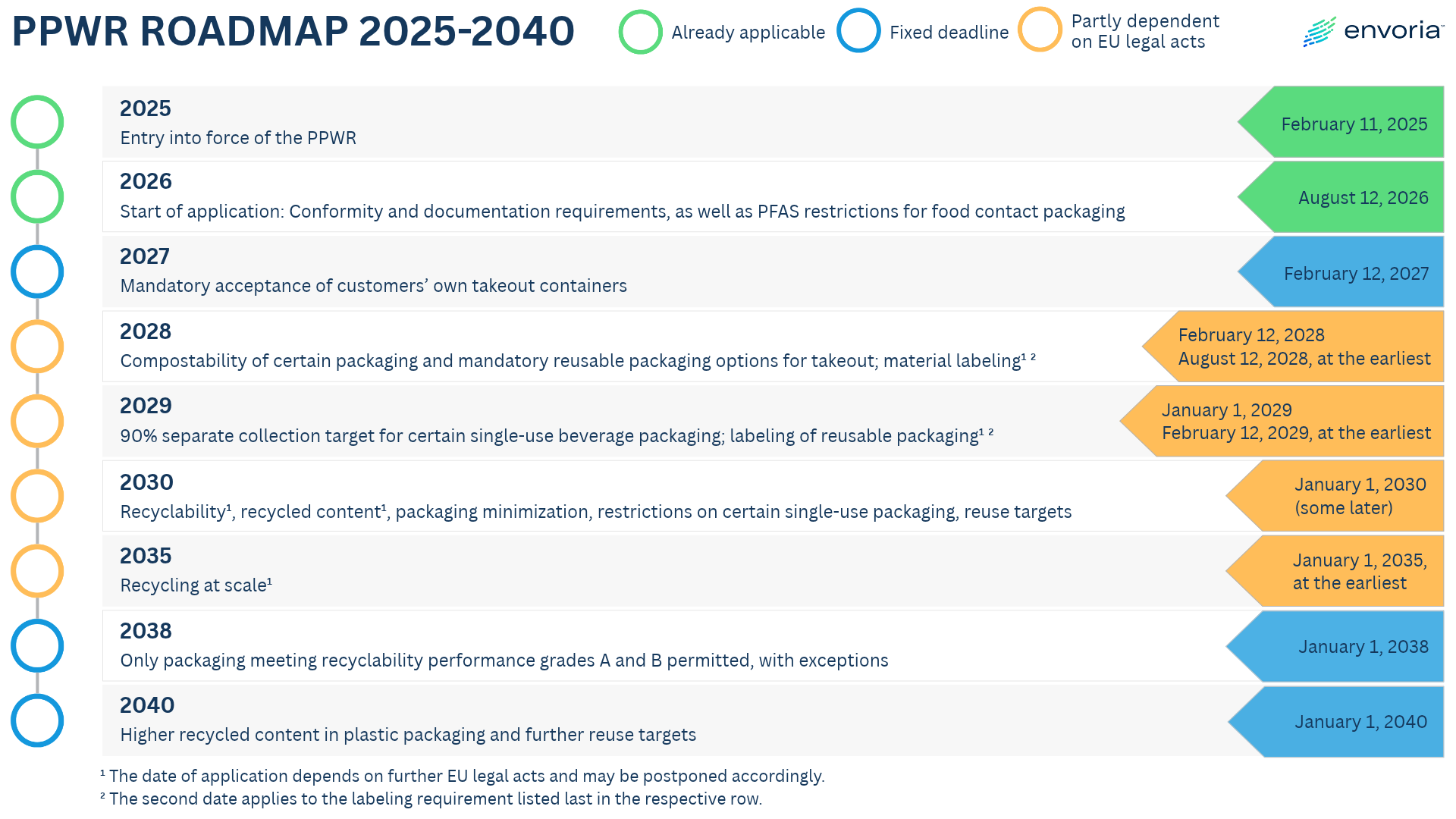
PPWR 2025–2040: Key Deadlines at a Glance
Which PPWR requirements already apply, and which will take effect in the coming years? The following overview summarizes the key deadlines through 2040, from the regulation’s entry into force and initial compliance obligations to stricter requirements for recyclability and minimum recycled content in plastic packaging.
Implementing the PPWR is particularly challenging for companies with extensive packaging portfolios spanning a wide range of materials and suppliers. Specialized software helps them manage packaging data, track applicable requirements, and monitor compliance.
But which PPWR software is the best fit for your business? In this comparison, we explore the key features and strengths of four providers and explain which solutions are best suited to different business needs.
Why Companies Need PPWR Software
The PPWR places greater demands on how companies manage and assess packaging data. They must collect complete and accurate information, evaluate packaging compliance, and demonstrate that their packaging meets the applicable regulatory requirements.
Many companies still manage packaging data in Excel spreadsheets, ERP systems, or document repositories. For small packaging portfolios, this is often sufficient. However, as portfolios become more complex and involve different materials, suppliers, and legal entities, managing this information without specialized software quickly becomes time-consuming, difficult to organize, and prone to errors. This increases the risk of overlooking data gaps, making incorrect packaging assessments, or failing to provide the required documentation on time. In the worst case, this can lead to PPWR violations and associated legal and financial consequences.
What Are the Benefits of PPWR Software?
Specialized PPWR software not only simplifies packaging data management but also helps companies assess and document compliance. Here are the five key benefits:
- Centralized packaging data management: Information on materials, components, weights, substances, and suppliers is managed centrally and linked to the corresponding packaging items. This prevents duplicate data entry and ensures data consistency.
- Identification of data gaps: Gap analysis and completeness checks reveal which data or supporting documents are missing. Companies can then address these gaps and request the necessary information from the relevant parties.
- Structured conformity assessments: Software enables companies to systematically assess individual packaging items against applicable PPWR requirements and document the results. When changes occur, the affected assessments can be reviewed and updated as needed.
- Traceable documentation: Technical documentation, certificates, test reports, and EU declarations of conformity, along with version histories and change records, help companies demonstrate compliance during internal audits and in response to regulatory inquiries.
- Improved cross-functional collaboration: Procurement, product development, packaging management, and compliance teams work with the same data. Clearly defined responsibilities, tasks, and approval processes improve coordination and make it easier to track progress.
What Should Companies Look for When Choosing PPWR Software?
PPWR software solutions differ primarily in their areas of focus. Some providers specialize in packaging management, recyclability, and sustainability analysis, while others focus on supplier management, conformity assessments, or compliance documentation. The right solution depends on a company’s packaging portfolio, existing data structures, and internal processes.
When evaluating PPWR software, companies should consider the following criteria:
- Comprehensive coverage of current and future PPWR requirements: Which regulatory requirements does the software already cover, and what additional features are planned? Providers should keep pace with the PPWR’s phased application dates and update their software in time to reflect regulatory changes.
- Depth of packaging data management: Can the software handle complex packaging structures, including individual components, materials, and substance data? Can products, suppliers, and supporting documents be clearly linked to specific packaging items?
- Gap analysis and data quality: Can the software detect missing, implausible, or inconsistent data? Can missing data points be assigned to the relevant team members and tracked until resolved?
- Conformity assessment and documentation: Does the software assess packaging against applicable PPWR requirements and support the preparation of technical documentation and EU declarations of conformity? Can assessments and supporting documents be updated when changes occur?
- Integration and automation: What data import options and integrations are available for existing ERP, PIM, or other systems? To what extent can data collection, quality checks, and document generation be automated?
- Workflows, auditability, and scalability: Can responsibilities, reviews, and approvals be clearly defined? Does an audit trail provide a traceable record of changes, reviews, and approvals? Can the software accommodate multiple legal entities, locations, and extensive packaging portfolios?
The 4 Best PPWR Software Solutions Compared
The following table compares four PPWR software providers across six key criteria. Each solution is scored on a scale of 1 to 3 based on its publicly documented features.
Provider | Packaging Data | PPWR Requirements | Gap Analysis | Documentation | Automation | Workflows & | Best Suited For |
|---|---|---|---|---|---|---|---|
Envoria | 3 out of 3 points | 3 out of 3 points | 3 out of 3 points | 3 out of 3 points | 3 out of 3 points | 3 out of 3 points | Mid-sized to large enterprises with complex packaging portfolios and comprehensive PPWR compliance processes |
VERSO | 3 out of 3 points | 3 out of 3 points | 3 out of 3 points | 3 out of 3 points | 2 out of 3 points | 3 out of 3 points | Mid-sized to large companies with complex supply chains and high supplier coordination needs |
CONSUST | 3 out of 3 points | 3 out of 3 points | 2 out of 3 points | 3 out of 3 points | 2 out of 3 points | 3 out of 3 points | Mid-sized to large companies with different PPWR roles requiring guided compliance processes |
leadity | 2 out of 3 points | 2 out of 3 points | 2 out of 3 points | 3 out of 3 points | 2 out of 3 points | 2 out of 3 points | Small and mid-sized companies focused on PPWR requirements and compliance documentation |
1. Envoria: Comprehensive PPWR Software for Integrated Compliance Management
Envoria offers AI-powered PPWR software that combines packaging data management, gap analysis, conformity assessments, and technical documentation in a single solution. Companies can capture packaging data down to the component level, link supporting documents, generate EU declarations of conformity, and manage compliance through integrated workflows and approval processes. The software supports complex packaging portfolios across multiple legal entities and locations and is continuously updated to reflect new PPWR requirements.
PPWR Software Features
- Centralized management of packaging, components, materials, weights, and substance data, including PFAS
- Direct links between packaging items, products, suppliers, and compliance documentation
- AI-powered extraction of packaging data from documents and generation of qualitative information
- Gap analysis, AI-powered plausibility checks, and identification of missing data and supporting documents
- Structured conformity assessments, including risk assessment, documentation of results, and identification of required actions
- Centralized management of technical documentation, test reports, and certificates, as well as AI-powered generation of EU declarations of conformity
- Task management, role-based permissions, review and approval workflows with dual control, and audit trails
- Data imports, REST API integration, and management of multiple legal entities and locations
Key Strengths
- Comprehensive PPWR compliance management: Coverage of all PPWR requirements within a single solution, from data collection and conformity assessments to compliance documentation
- AI-powered automation and data quality: Reduced manual effort, identification of data gaps, and reliable processing of packaging information
- Process controls and auditability: Clearly defined responsibilities, structured approval processes, and traceable changes
- Cross-functional collaboration: Consistent data and processes across departments, legal entities, and locations
- Integration and scalability: Flexible integration with existing systems, and efficient management of large, complex packaging portfolios
- Modular ESG and compliance platform: Integration with other Envoria modules to avoid disconnected software solutions
- Long-term PPWR compliance: Continuous software development in line with evolving regulatory requirements
Potential Limitations
Given its extensive functionality, Envoria is particularly well suited to companies with complex packaging portfolios and multiple departments involved in compliance. Smaller businesses with a limited number of packaging items and straightforward documentation requirements may not need the full range of features.
2. VERSO: PPWR Software Focused on Supplier Management
Through its Supply Chain Hub, VERSO offers PPWR software for managing packaging data, identifying regulatory roles and obligations, and generating compliance documentation. A particular focus is on automating data collection and communication with suppliers. By grouping similar packaging items, companies can reuse existing data and supporting documents.
PPWR Software Features
- Centralized management of packaging, components, materials, weights, and substance data, including PFAS
- Automatic identification of applicable PPWR roles and obligations for each packaging item
- Data validation, gap analysis, and conformity assessments of packaging components
- Automated supplier data requests with reminders and direct data collection
- Automated generation of technical documentation and EU declarations of conformity for individual or multiple packaging units
- Version control and archiving of compliance documents, with notifications of changes to packaging components
- Certificate management, action tracking, data imports, and REST API integration
Key Strengths
- Efficient supplier management: Reduced manual coordination and greater visibility into pending data and documentation requests
- Clear regulatory responsibilities: Automatic identification of applicable PPWR roles and obligations
- Reduced duplicate work: Reuse of packaging data and compliance documentation for similar packaging items
- Automated compliance documentation: Less manual effort in generating, updating, and sharing compliance documents
- Scalable supplier management: Standardized data collection and documentation across large packaging portfolios and numerous suppliers
- Integrated supply chain platform: Management of PPWR compliance alongside other supply chain and compliance requirements within a single platform
Potential Limitations
VERSO’s main strengths lie in supplier collaboration and automated data collection. Companies that manage most of their packaging data internally and require little input from suppliers may derive less value from these capabilities.
3. CONSUST: Guided PPWR Compliance with Automated Identification of Obligations
CONSUST’s FramesCube software includes a PPWR module that offers a structured approach to implementing the EU Packaging and Packaging Waste Regulation. The solution supports companies throughout the process, from collecting packaging data and automatically identifying regulatory roles and obligations to preparing compliance documentation. Its main focus is on guided PPWR implementation and centralized management of regulatory tasks.
PPWR Software Features
- Centralized management of packaging, products, and associated data
- Automatic identification of regulatory roles and obligations using a decision tree
- Compliance dashboard for tracking compliance status, tasks, and deadlines
- Supplier questionnaires and AI-powered extraction of packaging data from documents
- Generation of technical documentation and multilingual EU declarations of conformity
- Task management with assigned responsibilities, deadlines, and progress tracking
- Data imports, REST API integration, and management of multiple legal entities and locations
Key Strengths
- Guided PPWR compliance: Step-by-step implementation of regulatory requirements with built-in templates and guidance
- Automated identification of roles and obligations: Reduced effort in determining regulatory responsibilities
- Centralized compliance management: Clear overview of pending obligations, deadlines, and implementation progress
- Efficient supplier collaboration: Structured collection and assessment of packaging data and supporting documents
- Built-in regulatory guidance: Explanations, best practices, and templates to support independent implementation of regulatory requirements
- Modular ESG and compliance platform: Integration with other FramesCube modules and reuse of existing data and organizational structures
Potential Limitations
CONSUST focuses primarily on automatically identifying regulatory obligations and guiding companies through PPWR implementation. Companies looking to automate completeness and plausibility checks across large volumes of packaging data and conduct complex conformity assessments should take a closer look at the software’s data quality and automation capabilities.
4. leadity: PPWR Software for Managing Regulatory Requirements and Compliance Documentation
leadity offers PPWR software that brings packaging data, regulatory requirements, and compliance documentation together in one place. The solution helps companies identify applicable PPWR obligations, detect gaps in data and documentation, and organize the evidence needed to demonstrate compliance.
PPWR Software Features
- Centralized management of packaging and material data across products, markets, and packaging types
- Direct links between packaging items, supplier documents, certificates, and declarations of conformity
- Identification of applicable PPWR requirements and existing data gaps
- Overview of pending actions and areas requiring attention
- Generation and management of technical documentation and EU declarations of conformity
- Import of packaging data from existing systems and integration into business processes
Key Strengths
- Centralized PPWR requirements management: Management of regulatory obligations, actions, and supporting documents in one place
- Organized compliance documentation: Clear links between documents and packaging items, with easy access during audits
- Integration into existing processes: Incorporation of PPWR compliance into established workflows
- Visibility into implementation progress: Early identification of data gaps and areas requiring action
- Modular ESG and compliance platform: Integration with other leadity solutions
- Additional expert consulting: Expert guidance on interpreting and implementing regulatory packaging requirements
Potential Limitations
leadity focuses on managing PPWR requirements, packaging data, and compliance documentation. Companies with complex packaging portfolios should pay particular attention to the level of detail supported for individual components, materials, and substances. The software’s capabilities for automated data validation, conformity assessments, and review and approval workflows are also worth comparing more closely.
Conclusion: Which PPWR Software Is Best?
The best PPWR software depends on the specific needs of each business. Companies managing extensive packaging portfolios across numerous suppliers and legal entities need different capabilities than those with a small number of packaging items and straightforward documentation processes.
When evaluating software solutions, it is worth taking a close look at their features. Which PPWR requirements are already covered? How can packaging data be collected, validated, and analyzed? Does the software support conformity assessments and the preparation of the required documentation? And how well does it integrate with existing systems and processes?
Companies should also plan ahead, as many PPWR requirements will only take effect in the coming years. It is therefore important to evaluate each provider’s plans for future software development and choose a solution that meets both current and long-term needs.