The short answer
For financial years beginning on or after 1 January 2026, entities preparing financial statements under FRS 102 generally have to recognize a right-of-use asset and a lease liability for most leases as lessees.
In addition to initial measurement, they must account for lease term options, discount rates, index-linked adjustments and lease modifications. The challenge therefore goes beyond the calculation itself: it also requires complete contract data and a controlled ongoing process.
Who is affected by the changes?
FRS 102 applies to certain entities in the United Kingdom and the Republic of Ireland. The revised Section 20 affects lessees that actually apply FRS 102, including small entities reporting under Section 1A. Size alone does not determine which standard applies: eligible micro-entities may use FRS 105, while entities preparing IFRS financial statements apply IFRS 16. Group reporting requirements, legal eligibility, and exemptions must be considered separately.
The following size thresholds provide guidance on the applicable financial reporting framework and disclosure requirements. In both jurisdictions, entities generally need to meet at least two of three criteria. Special provisions, group considerations and rules on changes in size category may affect the classification.
United Kingdom – thresholds for financial years beginning on or after April 6, 2025:
|
Size category |
Turnover |
Balance sheet total |
Employees |
|---|---|---|---|
|
Micro |
up to £1m |
up to £0.5m |
up to 10 |
|
Small |
up to £15m |
up to £7.5m |
up to 50 |
|
Medium-sized |
up to £54m |
up to £27m |
up to 250 |
Republic of Ireland – increased thresholds for financial years beginning on or after January 1, 2024:
|
Size category |
Turnover |
Balance sheet total |
Employees |
|---|---|---|---|
|
Micro |
up to €0.9m |
up to €0.45m |
up to 10 |
|
Small |
up to €15m |
up to €7.5m |
up to 50 |
|
Medium-sized |
up to €50m |
up to €25m |
up to 250 |
Practical example: A small UK company applying FRS 102 with the disclosure exemptions in Section 1A must generally apply the new lease accounting requirements. An eligible micro-entity applying FRS 105 instead does not account for leases under FRS 102 Section 20. Irish thresholds are denominated in euros and should not be confused with the UK thresholds in pounds sterling.
What has changed in Section 20?
Previously, lessees distinguished between finance leases and operating leases; operating lease payments were generally recognized as an expense over the lease term. The revised Section 20 follows the IFRS 16 right-of-use model: for most leases, lessees now recognize a right-of-use (ROU) asset and a lease liability on the balance sheet. Lessor accounting remains largely unchanged.
Two important recognition exemptions cover short-term leases (generally no more than 12 months and without a purchase option) and leases of low-value assets. Section 20 does not prescribe a universal GBP or EUR monetary threshold for low-value assets. Instead, the value of the underlying asset when new must be assessed on an absolute basis, independently of materiality to the lessee. For example, land and buildings, production equipment and vehicles are not regarded as low-value assets under Section 20. Entities should document their assessment and apply their policy consistently.
For recognized leases, depreciation of the right-of-use asset and interest on the lease liability typically replace a single rental expense in the income statement. This affects total assets, leverage metrics and EBITDA, among other measures; the amount and timing of the impact on profit or loss depend on the contract.
What requirements do lessees need to meet?
At commencement, the lease liability is generally measured at the present value of the relevant future lease payments over the accounting lease term. The right-of-use asset includes the initial liability and, where applicable, advance payments, initial direct costs and restoration obligations, less lease incentives.
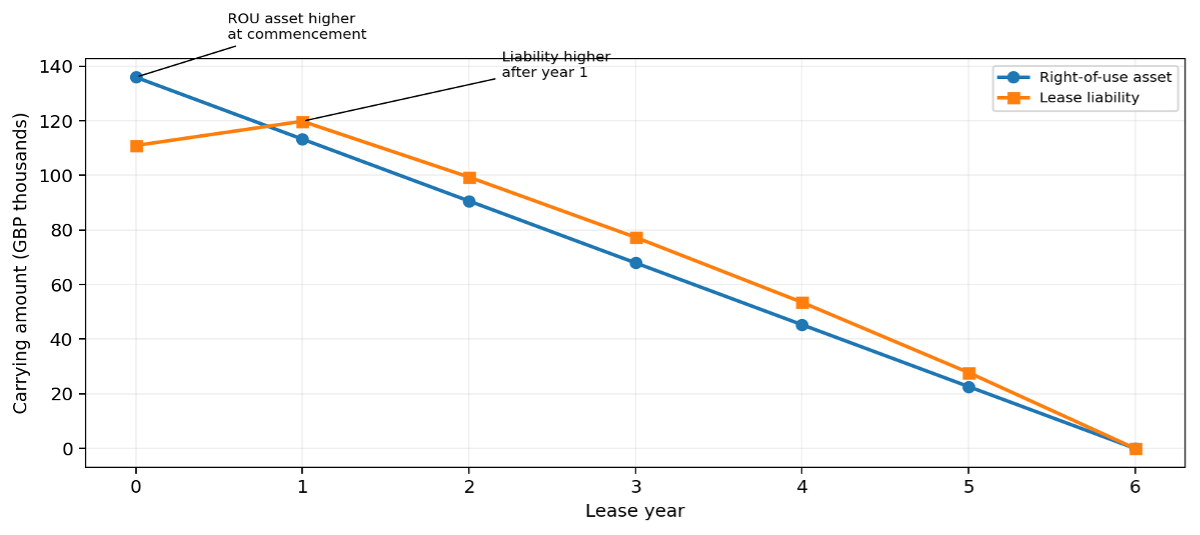
Subsequently, the right-of-use asset is normally depreciated, while the liability increases through interest and decreases through lease payments. The two carrying amounts therefore do not necessarily remain equal over time.
What disclosures are required under FRS 102?
The revised accounting rules also affect the notes to the financial statements. Under FRS 102 Section 20, lessees must disclose, among other items, interest expense on lease liabilities, expenses relating to short-term and low-value leases, variable lease payments not included in the lease liability, and total cash outflows for leases (FRS 102.20.80). A reconciliation of the carrying amounts of right-of-use assets from the beginning to the end of the reporting period, by class of underlying asset, is generally required, including additions, disposals and depreciation (FRS 102.20.81). Relevant disclosures about lease liabilities and their maturities are also required. Depending on the circumstances, additional qualitative disclosures may be necessary. Separate disclosure provisions or exemptions may apply to small entities under Section 1A and qualifying entities under Section 1. Data required for the notes should therefore be captured from the outset and maintained throughout the lease accounting process.
A separate follow-up article will explain the specific disclosure requirements, the structure of the maturity analysis and the available exemptions: “FRS 102 Section 20: What Must Lessees Disclose?” (coming soon).
Why can the right-of-use asset and lease liability differ?
This illustrative example assumes an advance payment of GBP 25,000 at commencement, a rent-free first year, and five annual payments of GBP 30,000 at the end of years 2 to 6. At an 8% discount rate, the initial lease liability is approximately GBP 110,900 and the right-of-use asset, including the advance payment, is approximately GBP 135,900. For illustration, the right-of-use asset is depreciated on a straight-line basis over six years.
When do options and contract changes require action?
Not every new piece of information triggers an immediate remeasurement. Four main categories are particularly relevant to subsequent lease accounting:
|
Trigger |
Required accounting action |
|---|---|
|
Lease term options |
Following a significant event or significant change in circumstances within the lessee’s control that affects the assessment of an extension or termination option, reassess the lease term. If it changes, remeasure the lease payments and liability using a revised discount rate. Actual exercise or non-exercise of an option previously assessed differently may also be relevant. |
|
Index- or rate-linked payments |
When the adjustment to contractual cash flows takes effect (for example, index-linked rent), update the remaining payments and remeasure the lease liability. The discount rate generally remains unchanged; different rules may apply when floating reference interest rates change. |
|
Residual value guarantee or purchase option |
Assess changes in expected payments under residual value guarantees or in the assessment of a purchase option and remeasure the liability as required. For changes in residual value guarantees, retain the original discount rate; for a change in the assessment of a purchase option, use a revised discount rate. |
|
Subsequent contractual modification |
Assess additional or reduced space, a renegotiated lease term, or changed consideration not provided for in the original contract as a lease modification. Determine whether a separate lease arises; otherwise adjust the existing accounting. A reduction in scope may require partial derecognition of the right-of-use asset with a gain or loss. FRS 102 allows the original discount rate to be retained in three specified circumstances; otherwise a revised rate is used. |
Accounting teams therefore need a change history that records effective dates, revised payment schedules, option decisions, and approvals. Contract changes must be assessed and classified before software can perform the appropriate recalculation. The key consideration is not merely when a change becomes known internally, but which contractual or accounting trigger under Section 20 applies.
How is the discount rate determined?
For new leases, the interest rate implicit in the lease takes precedence if it can be readily determined. This is the rate that equates the present value of lease payments and the unguaranteed residual value with the fair value of the underlying asset plus certain initial direct costs of the lessor. Lessees often lack the lessor information needed to calculate it.
If the implicit rate cannot be readily determined, FRS 102 Section 20 permits two alternatives: the incremental borrowing rate (IBR), reflecting the rate for comparable borrowing over a similar term and with comparable security and value; and the obtainable borrowing rate (OBR), reflecting the rate the lessee would pay to borrow, over a similar term, an amount equal to the total undiscounted lease payments included in the lease liability. The choice between IBR and OBR can be made lease by lease. Specific provisions apply to certain public benefit entities.
The FRC does not publish a mandatory table of standard discount rates. Supporting evidence may include actual loan offers, existing financing terms and suitable market or bank data. The term, currency, security, economic environment and creditworthiness should be appropriate to the lease. Entities should document the source, measurement date, assumptions and any subsequent changes. The relevant requirements are set out particularly in FRS 102.20.49 and the remeasurement and modification provisions in paragraphs 20.65–20.73.
What does the transition mean for existing leases?
Initial application must follow the modified retrospective approach (unlike the transition requirements for revenue recognition in Section 23, there is no choice of transition method for leases): the cumulative transition adjustment is recognized in equity at the date of initial application, without restating comparative figures. Existing leases must be identified, payment schedules and lease terms completed, available practical expedients assessed and opening balances determined. For leases previously classified as operating leases, the liability at the date of initial application is discounted using the lessee’s incremental borrowing rate (IBR) or obtainable borrowing rate (OBR) (FRS 102.1.51(a)); the implicit rate is not used for these leases. Practical expedients are available, including for discount rates, remaining lease terms and the assessment of options.
A special case concerns entities preparing individual financial statements under FRS 102 while already calculating IFRS 16 balances for group reporting. Subject to conditions, FRS 102.1.48 permits these existing carrying amounts to be used at the date of initial application. This does not mean an entity preparing IFRS financial statements must also report under FRS 102; it concerns parallel reporting under different accounting frameworks. The relief is limited to initial application.
What is the best approach to implementation?
For a small number of straightforward leases, a carefully controlled Excel solution may initially be sufficient. However, even a simple five-year lease can generate a substantial volume of journal entries: around 300 entries may arise from 60 months multiplied by five types of postings, for example depreciation, interest, payments, current/non-current reclassifications and one further regular posting type. This illustrative figure assumes no foreign-currency accounting and no lease modifications and is a practical estimate, not an FRS 102 requirement. The actual number depends on the chart of accounts, posting logic, frequency and interfaces. Foreign currencies, indexation, and modifications further increase complexity.
Specialist lease accounting software can manage contract data centrally, calculate payment and measurement schedules, maintain versioned records of changes and generate journal entries for the general ledger. Accounting teams remain responsible for assessing options, exemptions, discount rates and modifications. The objective is a documented process with clear responsibilities, controls and reconciliations.
Conclusion
FRS 102 Section 20 fundamentally changes lease accounting from 2026 for many UK and Irish entities applying FRS 102. Companies that establish the applicable reporting framework, capture complete contract data, and systematically monitor remeasurement triggers can reduce transition risks and ongoing effort. Particularly for multiple entities or larger lease portfolios, suitable software provides a reliable foundation for recurring calculations and journal entries.
How robust is your FRS 102 lease accounting process?
In a no-obligation FRS 102 process assessment, we review where manual effort and audit risks arise during transition and ongoing lease accounting: contract data, discount-rate methodology, remeasurement triggers, change history, controls, and posting processes.
You will receive a clear assessment of which parts of your lease accounting process are already robust and where action is needed.