ESG requirements are becoming increasingly complex and data-intensive. Artificial intelligence helps companies streamline processes and reduce the workload for business users in their day-to-day work.
AI automates recurring ESG tasks and reduces the manual effort required for data collection, research, and documentation.
Get analyses, recommendations, and assessments in seconds instead of hours of manual research.
For requirements such as CSRD/ESRS, carbon accounting, or ESG questionnaires, AI helps process large amounts of data in a structured way.
AI provides relevant ESG expertise directly within the workflow and supports users with technical questions.
AI can significantly accelerate ESG processes. However, traceable results and transparency are essential, especially when it comes to sustainability and compliance issues.
Many AI solutions promise to fully automate ESG tasks. However, when it comes to sustainability and compliance issues, it becomes critical if results are not traceable or sources are missing. At the latest during audits, inquiries, or internal approvals, transparency is needed instead of a black box.
Envoria therefore uses AI specifically as a support tool: for faster evaluations, intelligent suggestions, and more efficient ESG processes – but with human oversight, traceable results, and final approval by subject matter experts. This allows efficiency and professional assurance to be meaningfully combined.
Envoria combines the benefits of modern AI with the requirements for transparency, governance, and ESG expertise.
The EVA chatbot supports users directly within the Envoria platform and provides quick answers to questions about data, processes, and ESG requirements.

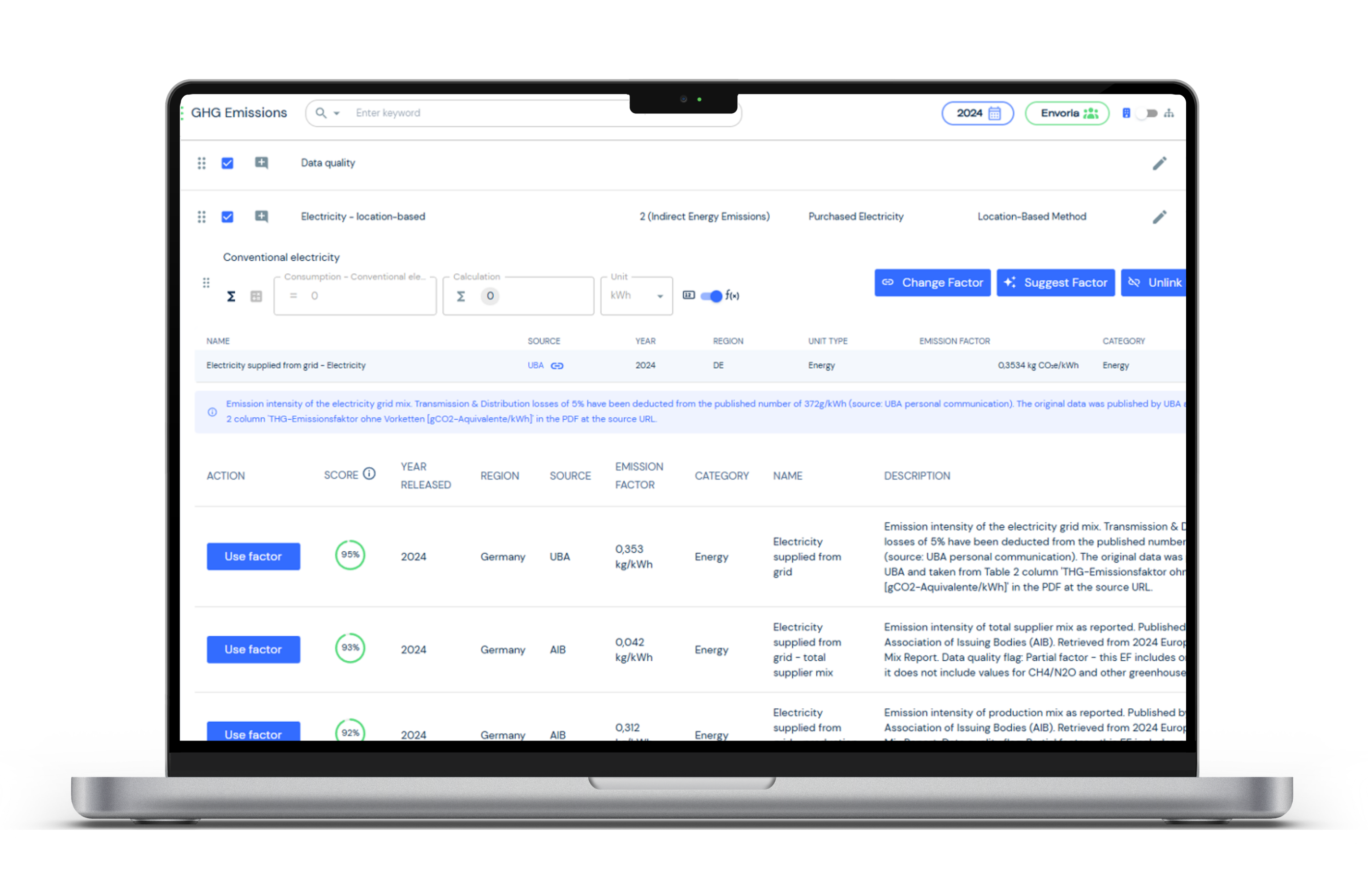
Selecting the right emission factors is one of the most time-consuming tasks in carbon accounting. Envoria uses AI to automatically match activity data with the most appropriate emission factors and categories.
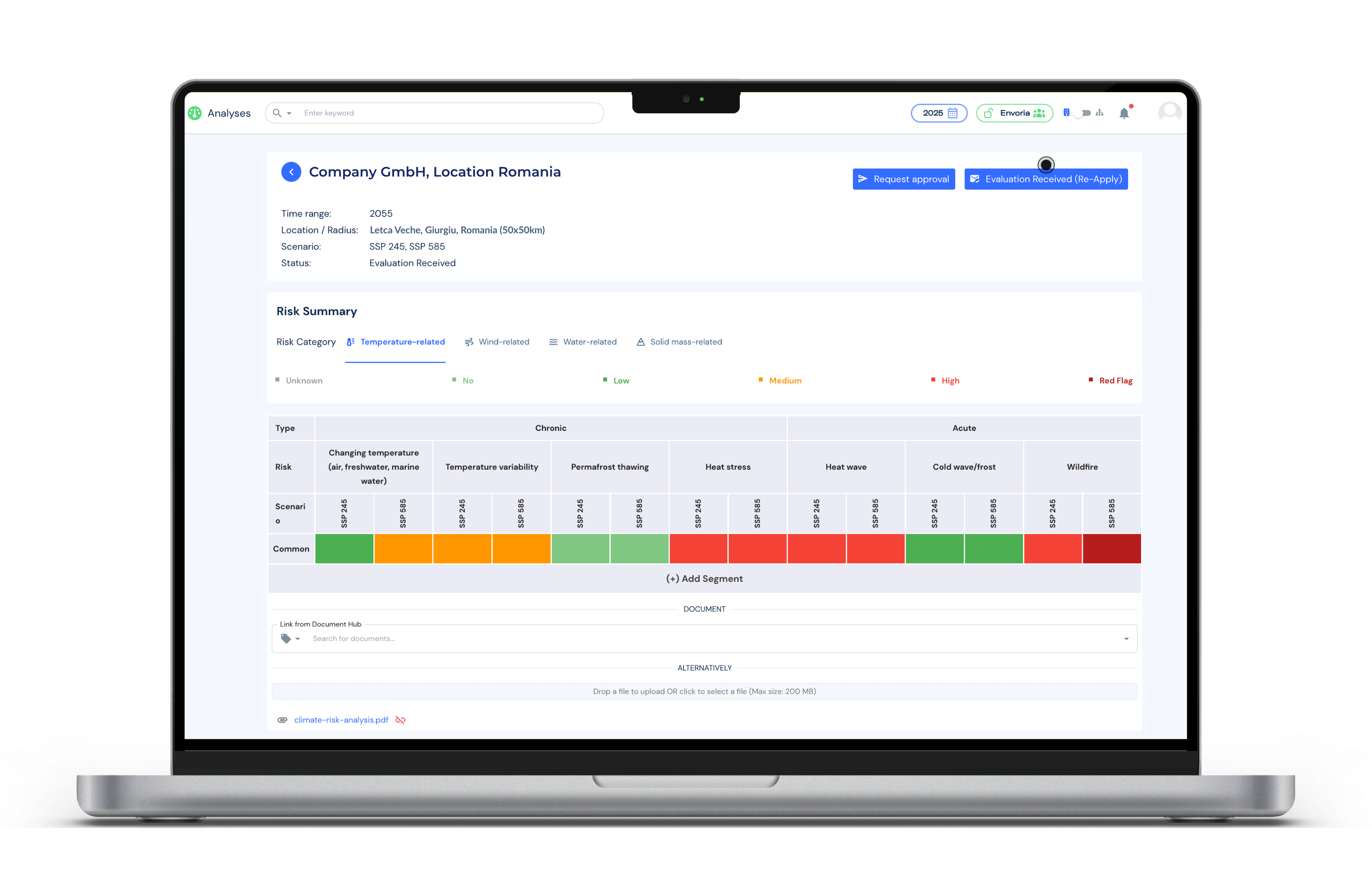
Assess potential climate risks for your locations. After selecting a location, time period, and climate scenario, the AI analyzes extensive climate and risk data and generates reliable risk assessments as well as detailed reports.
Create relevant Impacts, Risks, and Opportunities (IROs) for ESRS topics in just a few minutes. AI supports you in identifying, drafting, and structuring potential IROs based on the selected ESRS standards, providing a reliable foundation for your double materiality assessment.

Response AI helps companies process ESG questionnaires, supplier questionnaires, and ratings significantly faster. The AI automates time-consuming steps in the processing workflow and supports users from questionnaire recognition through to final approval.

ESG requirements are becoming increasingly complex and data-intensive. Artificial intelligence helps companies streamline processes and reduce the workload for business users in their daily tasks.
Our AI was developed specifically for our software and understands regulatory requirements, standards, and technical contexts.
Our AI was developed specifically for our software and understands regulatory requirements, standards, and technical contexts.
Envoria AI supports decisions but does not make them. Users and subject matter experts retain final approval at all times.
Transparent processes, documented sources, and traceable logic facilitate internal and external audits.
AI supports analyses, suggestions, and evaluations, reducing the effort required for time-consuming research and assessments.
European data centers, controlled data flows, and GDPR-compliant processing ensure the security of sensitive ESG data.
Models, processes, and changes are monitored and documented to ensure reliable results.
AI is used only after active approval, does not automatically access company data, and remains under your control at all times.




Artificial intelligence is transforming the way companies collect, analyze, and document ESG data. Particularly in the context of the CSRD, ESRS, EU Taxonomy, climate accounting, and sustainability ratings, AI helps evaluate large volumes of data more quickly, identify relevant information, and streamline ESG processes. Typical areas of application include the analysis of ESG documents, the mapping of data points to regulatory requirements, support for ESG questionnaires, the generation of text suggestions, and the assessment of climate and sustainability data.
At the same time, practical experience shows that AI should not be used in isolation in ESG management. Sustainability reporting is based on regulatory requirements, company data, supporting evidence, and expert assessments. Therefore, generic text generation is not sufficient. Successful ESG software combines AI with ESG expertise, structured data models, documented sources, and traceable workflows. This is precisely where the difference lies between a general AI application and professional ESG software with integrated AI support.
Many AI tools generate text based on general language models. However, this is not sufficient for ESG reporting, climate risk analysis, or regulatory requirements. Companies must be able to trace the data, sources, and assumptions on which results are based. Transparency, documentation, and technical validation are crucial, especially in the context of CSRD, ESRS, the EU Taxonomy, and external audits.
The AI in Envoria was developed specifically for ESG and compliance processes. It draws on ESG expertise, regulatory sources, internal knowledge databases, documented frameworks, and company-specific information. Answers and suggestions are not generated as mere text but within the context of ESG requirements, data structures, and stored evidence. Sources, documents, and the basis for decisions remain traceable and can be reviewed by subject matter experts at any time.
Furthermore, Envoria deliberately follows a human-in-the-loop approach. The AI supports ESG teams with analyses, assessments, and documentation tasks, but does not replace professional review. Decisions, approvals, and publications remain the responsibility of humans. This interplay of ESG expertise, AI support, and human oversight reduces risks associated with black-box results and increases the auditability of processes.
One of the biggest challenges in using AI for sustainability management is the traceability of results. Auditors, ESG managers, and stakeholders must be able to understand how assessments were generated and which data sources were used. This is precisely why Envoria relies on documented processes rather than unverifiable AI outputs.
For features such as ESG questionnaires, document analyses, or AI-powered response suggestions, sources, documents, and text passages are transparently identified. Users can trace the basis on which responses were generated, the evidence used, and where potential information gaps exist. Additionally, edits, adjustments, and approvals are documented.
Even in climate risk analyses, the assessment is not based exclusively on generative AI. Scientific climate models, geographic data, historical climate data, satellite data, and rule-based assessment logic form the foundation of the analysis. The AI assists with interpretation, risk classification, and report generation. This produces robust, reproducible, and auditable results that are suitable for regulatory requirements and external audits.
The use of AI in ESG management raises questions for many companies regarding data protection, data security, and governance. Sustainability data often contains sensitive information about supply chains, locations, emissions, key performance indicators, or strategic planning. That is why companies need clear guidelines for working with AI systems.
Envoria takes a controlled approach to this. AI functions are only used after active approval and can be activated on a customer-specific basis. Additionally, Envoria relies on European infrastructure, GDPR-compliant processes, and documented model versions.
It is also important that companies retain control over their data. AI serves as a supporting tool within defined ESG processes and does not access company information in an uncontrolled manner. This makes it easier to comply with regulatory requirements, data protection standards, and governance guidelines than with the uncontrolled use of general AI applications. Data security, traceability, and transparency thus become integral components of ESG processes.
Even the best ESG AI cannot replace expert knowledge. Companies still need expertise in ESG data, regulatory requirements, sustainability standards, and the interpretation of results. Many experts therefore see the greatest challenge not in the technology itself, but in the ability to correctly contextualize, critically evaluate, and technically validate AI results.
Four areas of expertise are particularly relevant for the successful use of AI in ESG management: an understanding of regulatory requirements such as the CSRD, ESRS, or EU Taxonomy; knowledge of data sources and ESG metrics; the ability to critically evaluate AI results; and an awareness of governance, transparency, and data protection. Companies benefit most when AI is used as an intelligent tool that supports subject matter experts rather than fully automating decisions.
This is precisely why Envoria relies on an approach where ESG expertise and AI work together. The software supports users in analyzing, documenting, and evaluating sustainability information, while professional responsibility remains with humans. This results in more efficient ESG processes without compromising the quality, traceability, or credibility of the results.