Curious?
From product and origin data to risk assessment, risk mitigation, and due diligence statements, we show you how to manage your EUDR due diligence obligations in Envoria simply and systematically.
Build a comprehensive data foundation to meet your due diligence obligations. In Envoria, you can combine relevant product and commodity information with origin, geolocation, and supply chain data.
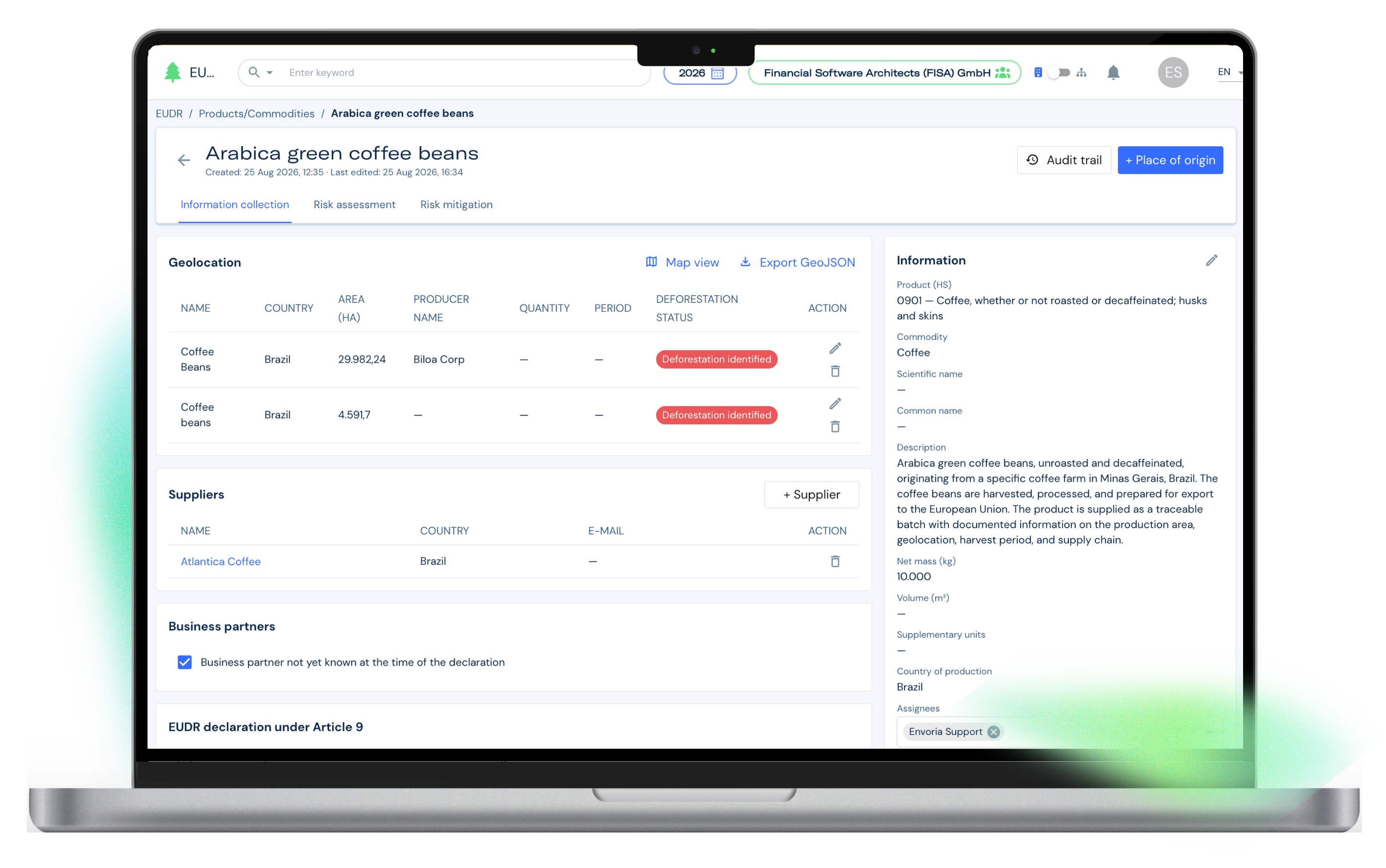
Link relevant commodities and products to the plots of land where they were produced and document their origin at the required level of granularity. Envoria brings geolocation information together with additional data such as country of production, producer, plot area, quantity, and production period.
Record geolocation data for the relevant plots of land and assign them to the respective product or commodity.
Use table and map views to clearly track production locations and the associated information.
Keep track of the deforestation status of recorded plots of land and identify problematic origin data directly within the EUDR process.
less manual effort with automated processes in Envoria
of total EU turnover at risk in fines. Reduce the risk with EUDR compliance
Audit trail with documented risks and actions
Inspection rate for high-risk countries: Stay compliant and prepared
Where necessary, include additional criteria and clearly document the information and assessment basis for your result.
Forest presence in the country of production
Deforestation and forest degradation risks
Data validity & traceability
Data quality & reliability
Indigenous peoples considerations
Corruption & lack of law enforcement
Document falsification & conflict risks
Conclusions of relevant expert groups
Certifications & verified evidence
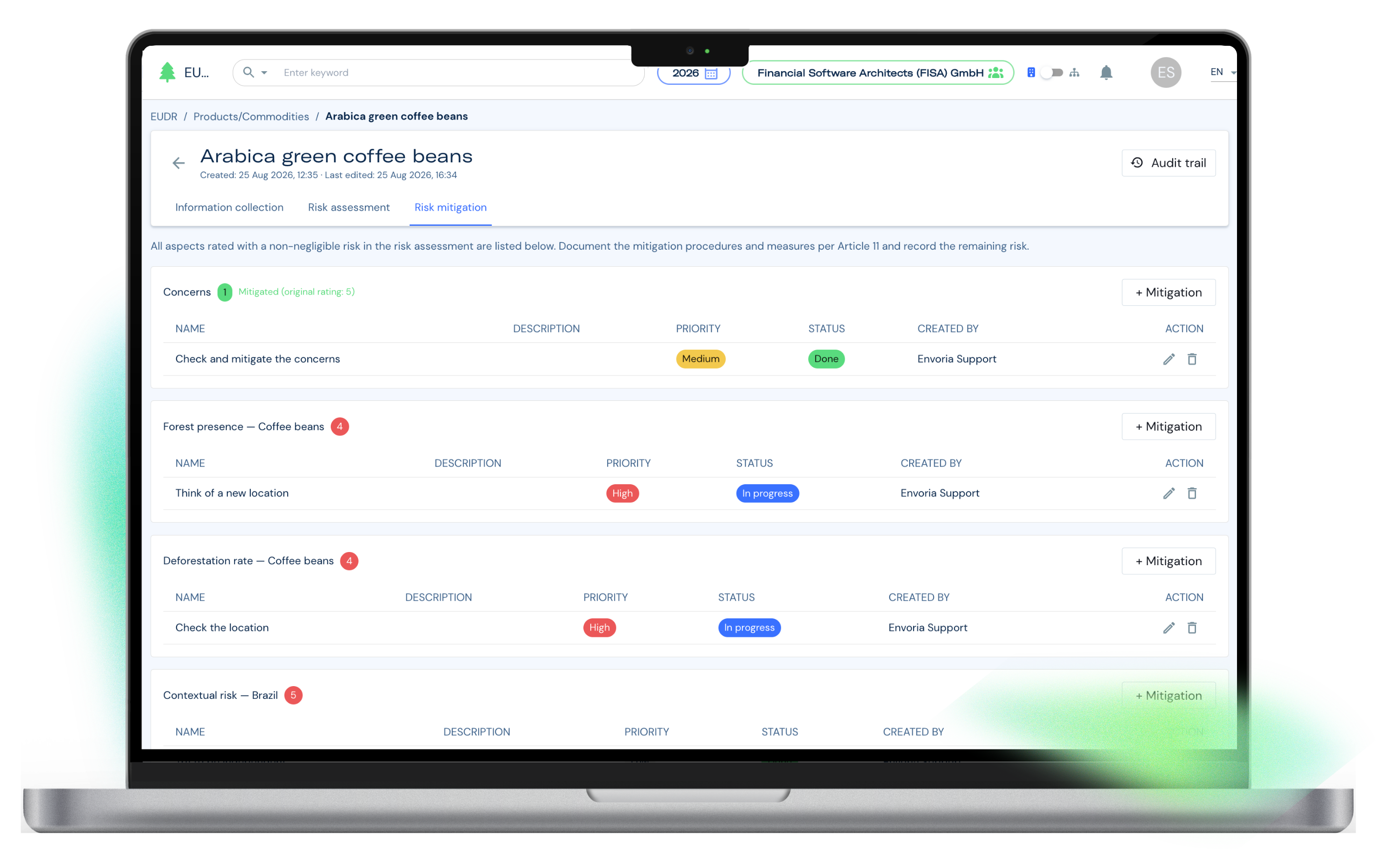
If a non-negligible risk is identified, continue the process directly in Envoria. Define appropriate risk mitigation measures and link them to the criteria for which a risk was previously identified.
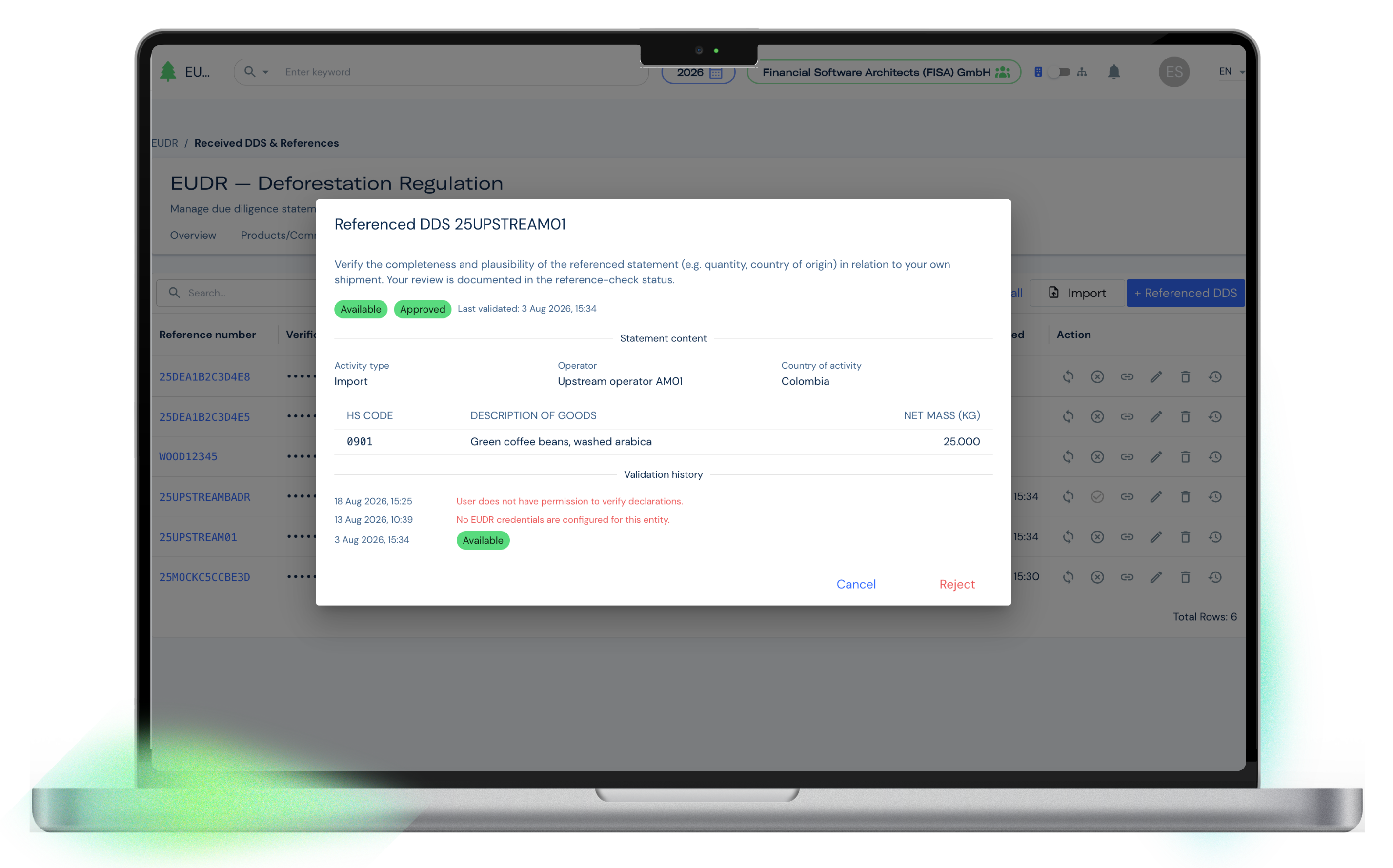
Consolidate the results of your due diligence and manage your due diligence statements directly in Envoria. Keep the associated reference and verification numbers centrally accessible in the Reference Manager.
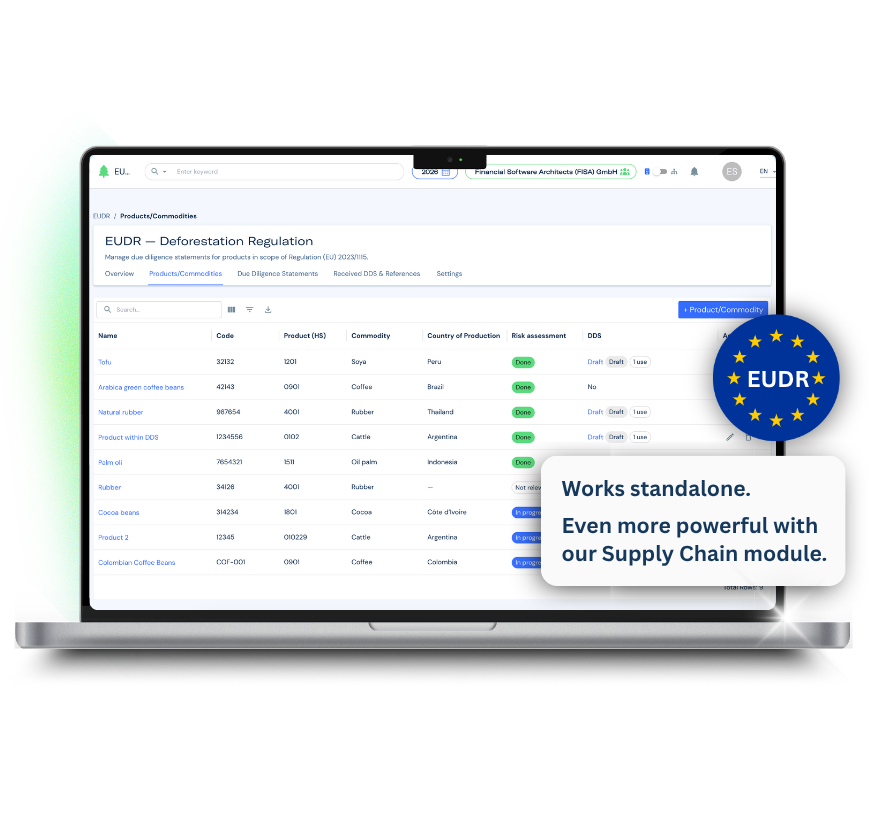
Use EUDR as a standalone solution or connect the module with Envoria Supply Chain Management.
Manage your EUDR due diligence obligations independently. Add suppliers and business partners directly within the EUDR process and assign them to the relevant products and commodities.
Extend EUDR with comprehensive supplier management. Use existing supplier data across modules and involve your suppliers directly in information gathering and EUDR processes.
An overview of the key features for your EUDR due diligence obligations and ongoing processes.
Keep track of compliance status, open tasks, pending assessments, and critical products in one central view.
Manage relevant products and commodities, including HS/CN codes, countries of production, and associated information.
Capture production plots and geolocation data and track origin and deforestation information in table and map views.
Systematically assess relevant EUDR risk criteria and document results and rationale in a traceable manner.
Link measures directly to identified risks and document their implementation and status.
Create and manage Due Diligence Statements based on product and risk information already available in Envoria.
Manage reference and verification numbers centrally and assign them to the relevant processes.
Use documented EUDR data, assessments, and processes for your analyses and reports.
Enter data manually, automate data exchange via REST APIs, or import data directly from the Envoria Supply Chain module.
Define which users can enter, edit, review, or approve EUDR data in the software.
Assign tasks, coordinate responsibilities, and keep track of open to-dos.
Manage EUDR processes across entities, locations, and areas of responsibility to create a shared data foundation.
EUDR software helps companies implement their due diligence obligations under the EU Deforestation Regulation in a digital and traceable manner. This includes, in particular, capturing and managing relevant product, commodity, origin, and geolocation data, conducting and documenting risk assessments and risk mitigation measures, and managing due diligence statements and reference numbers. A suitable solution should connect these steps in a seamless end-to-end process.
For EUDR-relevant products, companies must capture information including product details, quantities, countries of production, and origin information. Geolocation data for the plots of land where the relevant commodities were produced plays a particularly important role. Depending on the product and supply chain, additional information and supporting documentation may also be required for the subsequent risk assessment. In Envoria, product, origin, and production plot data can be brought together centrally and assigned to the relevant products and commodities.
Based on the information collected, companies must assess whether there is no or only a negligible risk. This assessment may take into account factors such as country and deforestation risks, supply chain complexity, risks of circumvention and mixing, and the quality and reliability of the underlying data. If a non-negligible risk is identified, appropriate risk mitigation measures are required. In Envoria, assessments can be documented and supported with a rationale, while measures can be linked directly to the risk criteria previously identified.
The Due Diligence Statement (DDS) is a key part of the EUDR process. It is prepared based on the information previously collected and the risk assessment carried out. In Envoria, relevant products and commodities can be assigned to the corresponding Due Diligence Statements, product and origin information can be transferred, and statements can be managed centrally. The associated reference and verification numbers can also be assigned to the relevant processes and used in subsequent workflows.
Yes. Envoria’s EUDR module can be used as a standalone solution or connected to other systems and Envoria modules. Data can be entered manually or exchanged via REST APIs. In combination with Envoria Supply Chain Management, existing supplier information can also be used, suppliers can be directly involved in data collection through questionnaires, and further supplier and risk analyses can be carried out. This allows EUDR to be managed either as a standalone compliance process or as part of a broader supply chain management approach, depending on your needs.